Educational Group Games for Team Building: 2026 Guide
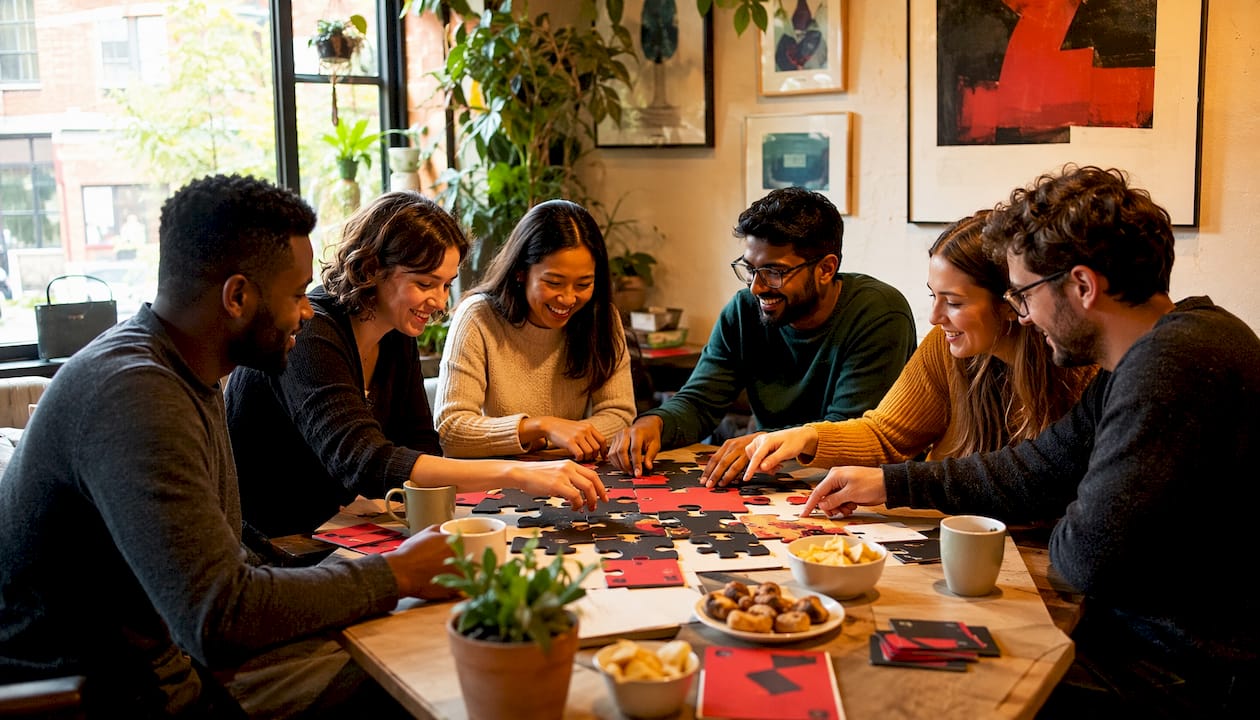
For themed escape-room bookings, the best educational group games combine a private immersive room (45–90 minutes) with a short tabletop warmup and a structured debrief. That three-part structure, brief welcome, game, guided reflection, consistently delivers stronger learning outcomes than any single activity alone. Here is what that looks like in practice:
- Private themed escape rooms (45–90 min): Best for immersive problem-solving, leadership spotting, and deep team bonding. Ideal group size: 6–10 per room.
- Escape-style tabletop games like Moo!: 30-minute runs that fit training breakouts or youth programs. Designed for roughly 5 players, ages 10–14, with a focus on spotting fake information.
- Quick icebreakers (5–15 min): Prime the group and introduce debrief prompts before a longer session.
Activities range from quick 5-minute icebreakers to multi-hour challenges, so you can match duration to your objective without overbuilding the agenda.
Table of Contents
- What types of educational group games fit a themed escape-room booking?
- How do you match a learning objective to the right game format?
- How do you book and run a themed escape-room session for learning outcomes?
- Three ready-to-run session plans for private bookings
- What do teams actually gain, and how do you measure it?
- What safety and accessibility checks should you run before booking?
- What are your next five steps before booking?
- Key Takeaways
- Why game design philosophy matters more than the game itself
- Book a private educational escape experience with Codebusters Escape Room
- Useful sources
What types of educational group games fit a themed escape-room booking?
Not every game format earns its place in a private booking. The five categories below cover the full range, from a 90-minute narrative room to a two-minute warmup.
Live themed escape rooms are the anchor format. Private rooms with narrative-rich puzzles (45–90 minutes) create the conditions for real leadership to surface, because someone has to organize the group under time pressure. Codebusters Escape Room’s themed rooms, including “Past to the Future,” “Stranger 80’s,” and “Flight of Deception,” are built for exactly this, with varying difficulty levels and group-size configurations.
Escape-style tabletop and card games like Moo! are the portable, repeatable cousin. A 30-minute session works well as a training breakout or a youth-program activity. The teach time is short, the materials fit in a bag, and the learning objective (media literacy, in Moo!'s case) is explicit.
Cooperative board and puzzle games carry a low facilitator load and work well for mixed-experience groups. For mixed corporate groups, games that balance social interaction with light strategy accommodate varied competitiveness and short teach times, which is why cooperative word-association formats often land well with cross-functional teams.
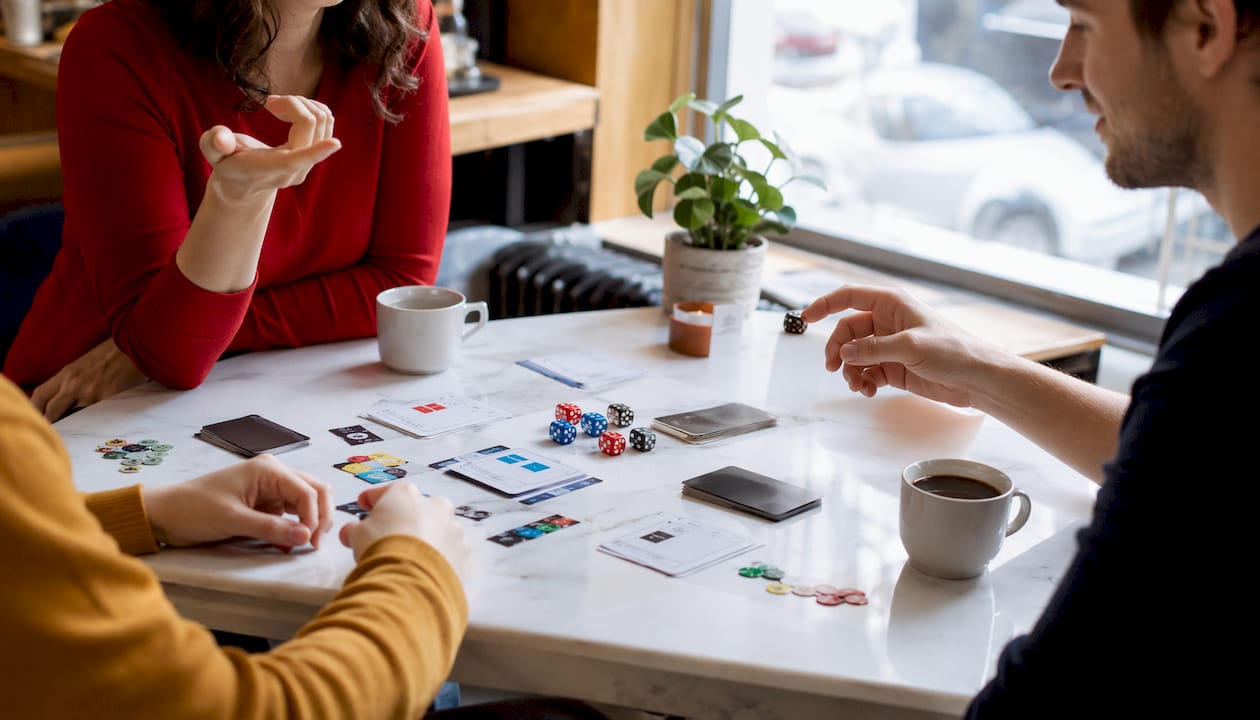
Social deduction and party games are fast to teach and useful as warmups. They build communication and social risk-taking without requiring a full room setup. Run one for 10–15 minutes before the main escape session to loosen the group.
Quick icebreakers and micro-challenges (5–15 minutes) prime participants and introduce the debrief vocabulary you will use later. Corporate icebreakers that actually work are worth having in your back pocket for this slot.
How do you match a learning objective to the right game format?
Pick the format by starting with the outcome, not the activity. The table below maps common learning objectives to the formats that deliver them most reliably.
| Learning objective | Best game format | Group size | Duration | Facilitator load | Materials/space | Cost shape |
|---|---|---|---|---|---|---|
| Critical thinking | Private escape room | 6–10 | 60–90 min | Moderate (staff on-site) | Dedicated room | Per-booking fee |
| Communication | Social deduction / party game | 6–20 | 15–30 min | Low | Table space | Low/free |
| Trust building | Cooperative board game | 4–6 | 30–60 min | Low | Table + game kit | One-time kit cost |
| Leadership spotting | Private escape room | 6–10 | 45–90 min | Moderate | Dedicated room | Per-booking fee |
| Media literacy / critical analysis | Escape-style tabletop (e.g., Moo!) | 4–6 | 30 min | Low | Tabletop kit | Low one-time cost |
| Large-group energy / inclusion | Simultaneous-play board games | 10–30 | 20–45 min | Low | Open floor or tables | Low/moderate |
A few sizing rules worth keeping:
- 4–6 players for tabletop learning games; more than six and someone goes quiet.
- 6–10 for a single private escape room; below six and the puzzle load feels thin.
- 10+ means splitting into parallel rooms or running mixed activities simultaneously. Games designed for large groups use simultaneous-play mechanics to prevent energy drop-off when you cannot split the crowd.
Higher immersion (a private themed room) increases facilitator load and cost but yields stronger experiential learning. A tabletop game costs less and repeats easily but cannot replicate the physical, narrative tension of a live room.
How do you book and run a themed escape-room session for learning outcomes?
A reproducible booking checklist saves you from the most common day-of surprises.
- Choose the room and slot. Select a private booking (not a public slot) so the debrief stays confidential and the group dynamic is controlled. Match room difficulty to the group’s experience level using a room selection guide.
- Confirm headcount and accessibility needs. Ask about mobility requirements, sensory sensitivities, and any medical needs at least 48 hours out. Codebusters Escape Room accommodates corporate groups with private-room configurations; confirm specifics when booking.
- Brief the facilitator. Share your learning objectives before the session. Codebusters’ staff can adjust the pre-game briefing to prime participants for the skills you want to observe.
- Prepare debrief prompts. Write three targeted questions tied to your objectives before the day. Generic “how did that feel?” prompts waste the debrief window.
- Plan for late arrivals and early finishers. Have a 5-minute micro-challenge or reflection card ready so no one sits idle.
Day-of timeline:
- 10–15 min: Arrival, welcome, and objective framing
- 45–90 min: Game
- 15–20 min: Structured debrief with targeted prompts
Without a guided debrief, the learning objectives are often lost entirely. That 15–20 minutes is not optional.
Pro Tip: Build at least one debrief prompt that asks participants to name a specific in-game communication choice that changed the outcome. That level of specificity transfers more readily to workplace behavior than open-ended reflection.
Three ready-to-run session plans for private bookings
30-minute tabletop plan (e.g., Moo!)
- Arrival and setup (5 min): Distribute game materials, state the learning objective (today: spotting misleading information), and explain the rules.
- Gameplay (20 min): Run one full round. Facilitator observes without intervening.
- Micro-debrief (5 min): Ask: “Which clue fooled you most, and why?” Then: “Where does that happen at work?”
Materials: Moo! card kit, table space for 4–6 players. If a player drops out: rotate them in as observer with a note-taking card.
60-minute private room plan
- Arrival and brief (10 min): Welcome, safety overview, objective framing.
- Gameplay (40 min): Private room session. Facilitator notes leadership moments from outside.
- Structured debrief (10 min): Three prompts: What role did you play? What would you do differently? What does that tell you about how your team communicates under pressure?
If the group finishes early: run a quick “rose/thorn/bud” reflection round while still in the room.
90-minute immersive room plan
- Arrival and brief (15 min): Introductions, learning objectives, icebreaker question.
- Gameplay (60 min): Full immersive themed session.
- Extended debrief and reflection (15 min): Structured discussion plus a one-page post-game survey sent within 24 hours to capture applied behavior one week later.
For screen-free group activities that work alongside these plans for mixed-age or family bookings, a few low-tech puzzles and physical challenges fill gaps without requiring extra equipment.
What do teams actually gain, and how do you measure it?
Shared experiences outside daily workflows build trust and encourage collaboration in ways that a meeting or training deck cannot. The documented benefits from HR and team-building practitioners include improved morale, stronger cross-functional communication, and higher retention of learned behaviors when the session includes a structured debrief.
The educational benefits of escape-room mechanics are well-documented: time pressure, narrative stakes, and physical puzzle-solving activate engagement in ways passive learning does not.
Measurement checklist:
- Pre-event (1 question): “On a scale of 1–5, how well does your team communicate under pressure?” Baseline captured.
- Facilitator observation: Note who leads, who goes quiet, and who bridges disagreements during the game.
- Post-event survey (within 24 hours): Three questions on what participants learned and what they plan to do differently.
- One-week follow-up: One question: “Have you applied anything from the session?” A yes/no with a one-line example is enough to detect applied change.
High-visibility feedback moments during the game, a countdown clock, a score reveal, a visible progress indicator, create the emotional peak that makes the experience memorable and improves post-event recall.
What safety and accessibility checks should you run before booking?
Run this checklist before you confirm any group booking.
Accessibility:
- Confirm step-free access to all rooms used.
- Ask about alternative puzzle paths for participants with limited mobility.
- Check that signage and instructions are available in large print or audio if needed.
Safety:
- Verify emergency exit locations and confirm staff monitoring protocols.
- Collect medical needs (allergies, claustrophobia, heart conditions) on the booking form.
- Confirm age-appropriate content for mixed-age groups; some themed rooms carry mature narrative elements.
Inclusion:
- Provide content warnings for any sensitive themes (horror elements, confined spaces, loud sounds).
- Assign low-pressure roles (note-taker, timekeeper) for participants who may feel overwhelmed by competitive dynamics.
- For family bookings with children, keeping kids engaged in transitions between activities matters as much as the main event.
Pro Tip: Send a one-paragraph pre-event brief to all participants 48 hours before the session. Include the room’s intensity level, what to wear, and a note that no prior escape-room experience is needed. It cuts anxiety and improves first-puzzle engagement.
What are your next five steps before booking?
- Pick your primary learning objective (communication, trust, critical thinking, or leadership).
- Choose session length based on the table in the matching section: 30 minutes for tabletop, 60–90 minutes for a private room.
- Confirm headcount and accessibility needs at least 48 hours before booking.
- Reserve a private room or tabletop kit. Private slots fill faster than public ones for corporate dates.
- Schedule the debrief as a calendar block, not an afterthought. Block 15–20 minutes immediately after the game ends.
Before the event, send one baseline question to participants: “How well does your team currently handle pressure together?” That single data point lets you measure real change after the session.
Key Takeaways
The most effective educational group game format pairs a private themed escape room with a structured debrief, because the debrief is where the learning actually sticks.
| Point | Details |
|---|---|
| Best format by objective | Private escape rooms for leadership and critical thinking; tabletop games for media literacy and communication warmups. |
| Ideal group sizes | 4–6 for tabletop games; 6–10 for a single private escape room; 10+ requires parallel rooms or mixed activities. |
| Session structure | Brief welcome (10–15 min), game (30–90 min), guided debrief (15–20 min) — skip the debrief and the learning is lost. |
| Measure outcomes | One pre-event baseline question plus a one-week follow-up check detects real applied change. |
| Codebusters Escape Room | Offers private-room bookings with themed narrative rooms in Colorado Springs, sized for corporate groups, parties, and family events. |
Why game design philosophy matters more than the game itself
Most planners spend 80% of their planning time picking the activity and about two minutes on the debrief. That is backwards. The game creates the shared experience; the debrief creates the learning. A well-designed escape room gives you the raw material, but a facilitator who asks the right questions afterward is what turns a fun hour into a behavior change.
At Codebusters Escape Room, being veteran- and family-owned shapes how rooms are designed. The priority is not maximum difficulty or theatrical spectacle for its own sake. It is building puzzles that require genuine collaboration, where no single person can solve everything alone, because that is the condition under which real team dynamics surface. Private bookings matter for the same reason: a group that knows each other (or is learning to) needs a controlled environment, not a public slot where strangers dilute the dynamic.
The award-winning status and the repeat corporate bookings are signals, but the more useful proof point is simpler: groups that debrief well leave with something they can name. That is the design goal.
Book a private educational escape experience with Codebusters Escape Room
If you have read this far, you already know what you need: a private room, a clear learning objective, and a structured debrief. Codebusters Escape Room delivers the first part, and this guide gives you the second and third.
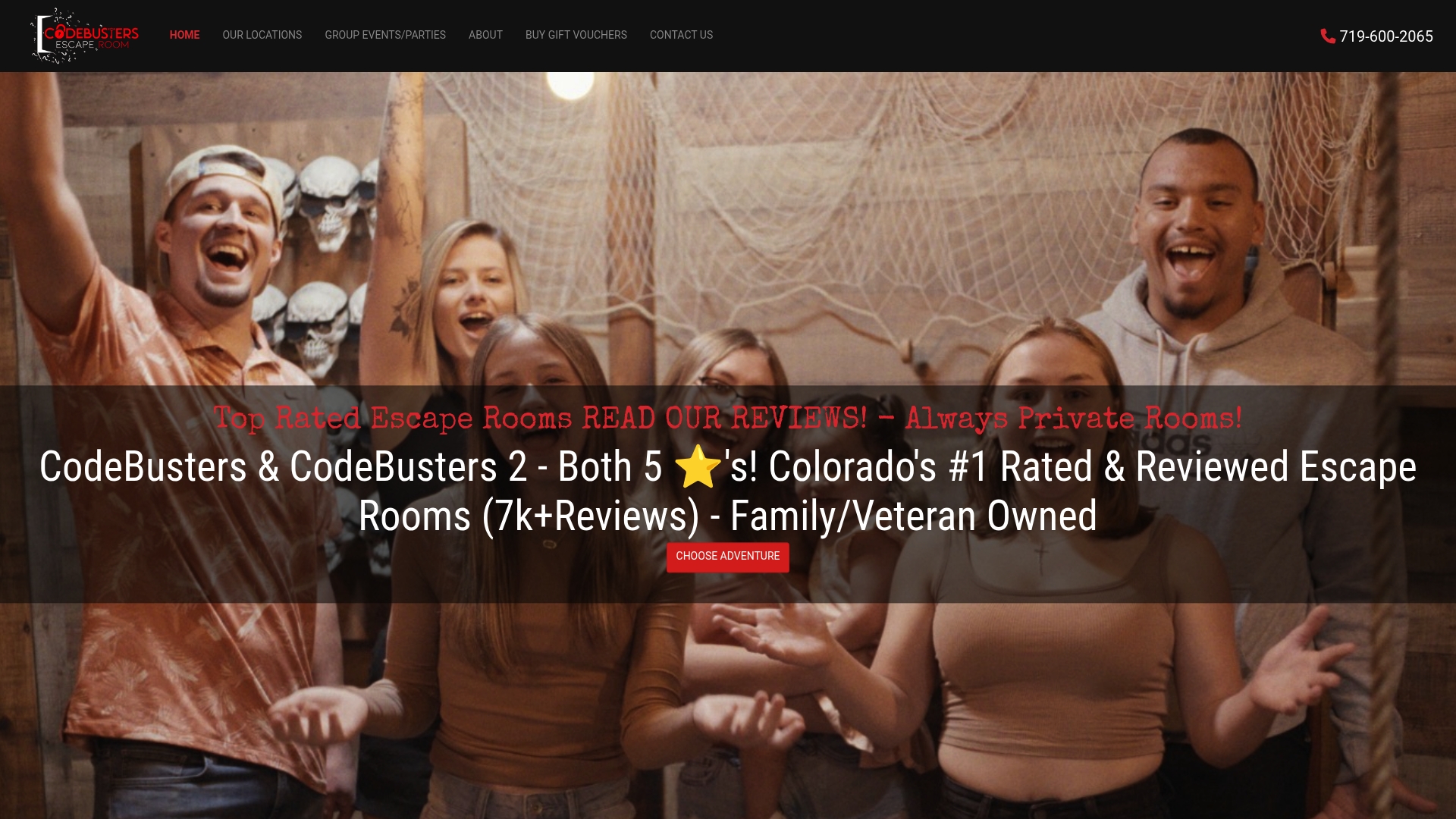
Codebusters Escape Room is a veteran- and family-owned Colorado Springs operation with private-room bookings available for corporate teams, school groups, parties, and family events. Themed rooms like “Past to the Future” and “Flight of Deception” are built for groups of varying sizes and experience levels, with staff who can support your facilitator briefing for corporate sessions. Gift vouchers are available for flexible scheduling.
Reserve your private room now, or explore corporate event packages to find the session length and room that fits your group’s objective.
Useful sources
- 50 Indoor Team-Building Activities Your Team Will Actually Enjoy — Gusto HR guidance on activity durations and skill targeting.
- 45 Team Building Games to Bring Teams Together at Work — Asana resource on shared experiences and collaboration outcomes.
- 53 Team Building Activities to Improve Teamwork (SessionLab) — Practitioner guidance on facilitation and the debrief imperative.
- Moo! Educational Escape Game — Product page for the 30-minute tabletop escape-style game used as a session example.
- Best Party Games (Wirecutter/NYT) — Recommendations for mixed-group cooperative and social deduction games.
- Best Board Games for Large Groups (BuzzVerdict) — Design principles for scaling group games without a dedicated moderator.
- Tower Builder — QuizDrift — Design insight on high-visibility feedback mechanics and emotional engagement.
- Codebusters Escape Room — Official site for private-room bookings, themed rooms, and corporate event packages in Colorado Springs.