Escape Room Metrics for Team Performance: 2026 Guide

Escape room metrics for team performance are quantifiable indicators that measure how a team communicates, collaborates, and solves problems under pressure. Corporate team leaders and HR professionals increasingly use these measures to turn a 90-minute activity into hard evidence of team strengths and gaps. A 2026 mixed-reality study with 24 teams confirmed significant improvements in cohesion and performance scores through escape room gameplay. The industry recognizes two metric categories: outcome metrics, which capture success or failure, and process metrics, which reveal how a team got there. Both are required for a complete picture of team dynamics.
What are the key escape room metrics for team performance?
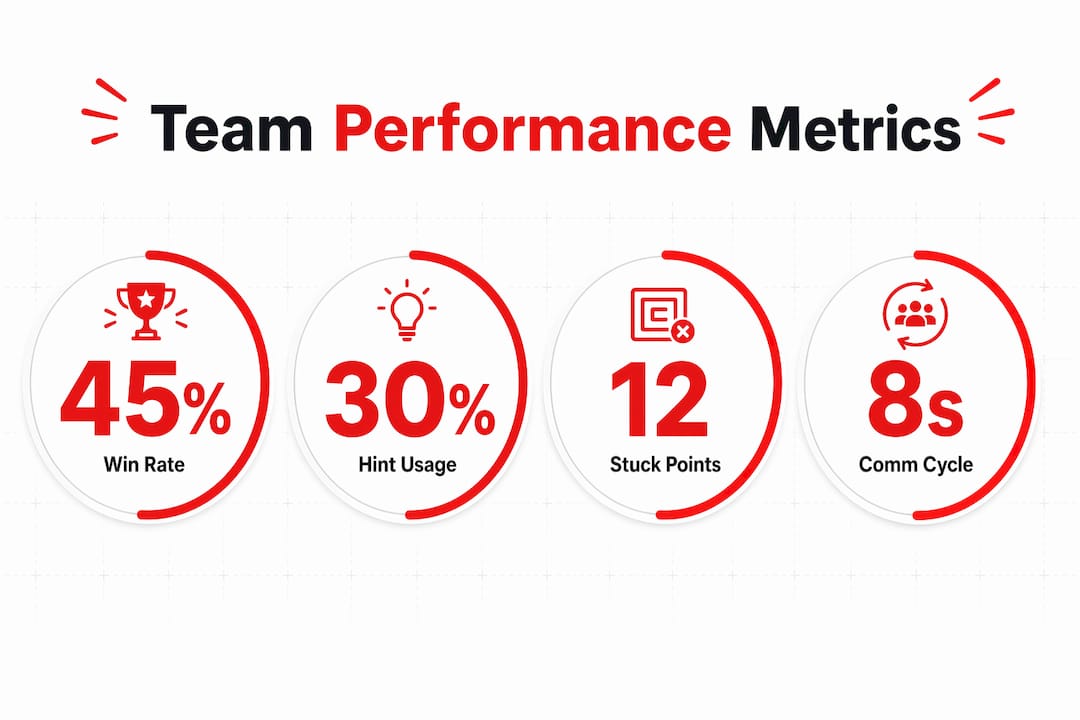
Outcome metrics are the starting point for any performance evaluation in teams. The most widely tracked are completion rate and win rate. Industry benchmarks recommend a win rate target of 30–50% to balance challenge with satisfaction. A win rate below 30% suggests the room is too difficult or teams lack preparation. A win rate above 50% signals the challenge is too easy to generate meaningful data.
Beyond win rate, corporate bookings benefit from tracking these outcome metrics:
- Completion rate: The percentage of teams that finish all puzzles within the time limit.
- Time to completion: How long a team takes from start to finish, measured in minutes.
- Hint usage rate: The number of external guidance requests per session. Fewer hints indicate stronger independent problem-solving.
- Puzzle sequence efficiency: Whether teams solved puzzles in a logical order or backtracked repeatedly.
- Average group size vs. performance: Larger groups do not automatically perform better. Tracking this ratio reveals whether your team scales collaboration or fragments under size.
Room utilization rate and booking frequency for corporate groups are secondary KPIs worth monitoring. High repeat booking rates correlate with strong team experiences and NPS scores of 60–80+, which signal that teams found the activity genuinely valuable.
Pro Tip: Set your difficulty target before the session, not after. If your goal is leadership development, a 35% win rate room creates more useful data than an easy room where everyone succeeds.
How do process metrics reveal team dynamics?
Process metrics go deeper than win or lose. They capture the texture of how a team actually functions during an escape room challenge. Tracking stuck points, including their duration and frequency, directly measures a team’s collective problem-solving ability. A team that gets stuck repeatedly on the same type of puzzle reveals a shared blind spot, not just bad luck.
The most useful process metrics for measuring team dynamics include:
- Stuck point frequency: How many times the team stalled for more than two minutes on a single puzzle.
- Communication pattern: Whether team members spoke in short, frequent exchanges or in long, infrequent monologues.
- Role delegation: Did one person dominate decisions, or did leadership shift based on who had the relevant skill?
- Confidence vs. accuracy: Did teams act on wrong assumptions confidently, or did they pause to verify before committing?
- Cognitive load distribution: Were tasks spread across the group, or did two people carry the entire workload?
High-frequency, short-cycle communication and clear role delegation predict escape room success more reliably than technical skill alone. Teams that fail to distribute cognitive load early face bottlenecks and poorer outcomes. This mirrors real workplace dynamics, which is exactly why HR professionals find the data so transferable.
Pro Tip: Record the debrief session immediately after the escape room. Teams are most candid in the first 15 minutes. Ask each member to name one moment they felt the group stalled and why. That answer is your most valuable process metric.

How do you capture and analyze escape room performance data?
Measurement methods fall into two categories: observation-based and technology-supported. Both have a place in corporate team building analysis, and the best programs combine them.
-
Direct observation with a structured rubric. A trained facilitator watches the session and scores behaviors like communication frequency, leadership emergence, and task delegation. This method captures nuance that technology misses, such as body language and tone.
-
AI-driven performance tracking. AI-driven systems can track puzzle-solving patterns, communication under pressure, and confidence versus accuracy in real time. These tools identify standout performers and flag teams that over-rely on a single leader.
-
Pre- and post-activity surveys. Anonymous surveys asking about voicing opinions and confidence in teammates reveal gains in psychological safety and trust. Run the same survey before and after the activity to measure change, not just sentiment.
-
Timed puzzle logs. A simple timestamped log of when each puzzle was solved shows where teams accelerated and where they stalled. This data maps directly onto time-to-solution metrics.
-
Paired metric models. Tracking success rate alongside communication efficiency prevents misleading conclusions. A team that wins quickly but only because one person solved everything has a very different profile than a team that wins through distributed effort.
The most effective corporate programs use all five methods together. Qualitative debrief data gives context to the numbers. Quantitative logs give the debrief structure. Neither works as well alone. For corporate event planners building a measurement framework, engagement metrics from structured activities provide a useful reference point for how to design pre and post measurement cycles.
How do you apply escape room metrics to improve team performance?
Metrics only create value when they connect to specific workplace behaviors. The translation step is where most corporate programs fall short. A team that scores poorly on role delegation in an escape room almost certainly has the same problem in project meetings. The escape room just makes it visible faster.
Use metric data to drive these specific interventions:
- Low communication frequency: Schedule structured stand-up formats for the team’s next three project cycles. Measure whether meeting participation rates improve.
- High hint usage rate: Assign the team a problem-solving framework like the OODA loop (Observe, Orient, Decide, Act) and run a follow-up escape room session in 60 days.
- Single-leader bottleneck: Rotate the designated decision-maker role across team members for one quarter. Track whether project delivery timelines improve.
- Poor puzzle sequence efficiency: Run a process mapping workshop focused on prioritization. Teams that backtrack in escape rooms often backtrack in project planning too.
Team dynamics and game experience reinforce each other, meaning the escape room itself builds the skills it measures. This makes repeat sessions especially valuable. Run an initial session to establish a baseline, then schedule a follow-up session 90 days later using the same room or a comparable difficulty level. Compare win rate, hint usage, and stuck point frequency across both sessions to measure growth.
Escape rooms build stronger teams most effectively when the activity connects to a defined development goal. Set that goal before booking, not after. HR professionals who tie escape room outcomes to existing competency frameworks, such as communication, collaboration, and adaptability, produce the most defensible performance evaluation data.
Pro Tip: Share the metric report with the team, not just leadership. Teams that see their own data take ownership of the improvement. Transparency accelerates behavior change faster than top-down feedback alone.
Key Takeaways
Escape room metrics deliver the most value when outcome data and process data are combined into a single performance evaluation cycle.
| Point | Details |
|---|---|
| Target win rate | Aim for a 30–50% win rate to generate meaningful performance data without demoralizing teams. |
| Process metrics matter most | Stuck point frequency, communication patterns, and role delegation reveal more than win or lose alone. |
| Combine measurement methods | Pair AI tracking and timed logs with pre/post surveys and structured debriefs for complete data. |
| Connect metrics to workplace goals | Map escape room findings to specific competency gaps and assign follow-up interventions. |
| Repeat sessions measure growth | Run a follow-up session 90 days after the baseline to track measurable improvement over time. |
What I’ve learned from watching teams under pressure
Most HR professionals expect the high performers to shine in an escape room. They rarely do, at least not in the way anyone predicts. The quiet analyst who never speaks in meetings often becomes the person who cracks the hardest puzzle. The confident manager who runs every meeting frequently becomes the bottleneck who slows the whole group down.
That gap between perceived performance and observed performance is the most valuable thing escape room metrics surface. No 360-degree review captures it as cleanly. The data does not lie, and the team cannot argue with what they experienced together.
The biggest mistake I see corporate leaders make is treating the escape room as a reward rather than a diagnostic tool. When you frame it as a fun outing, you lose the measurement opportunity entirely. When you frame it as a structured assessment with a debrief and a follow-up plan, the ROI becomes real and defensible.
Context matters as much as the numbers. A team under unusual stress from a recent reorg will score differently than the same team six months later. Always note the organizational context when you record baseline metrics. Without that context, the data misleads more than it informs.
The role of communication in escape rooms is not a soft skill observation. It is a measurable behavior with a direct line to project outcomes. Treat it that way, and your escape room data becomes one of the most credible inputs in your team development program.
— CodeBusters
Codebusters Escape Room: built for corporate teams who want real results
Corporate teams that want measurable outcomes need more than a fun activity. They need a well-designed experience with the structure to support real performance evaluation.
Codebusters Escape Room in Colorado Springs offers private room bookings designed for corporate groups, with themed rooms like “Flight of Deception” and “Past to the Future” built for different group sizes and challenge levels. The team provides structured debrief support so your metric data connects directly to your development goals. Whether you are running a baseline assessment or a follow-up session to measure growth, Codebusters Escape Room gives you the environment to make it count. Book your corporate session and turn your next team building activity into a performance evaluation that HR can stand behind.
FAQ
What are escape room metrics for team performance?
Escape room metrics for team performance are quantifiable measures, including win rate, hint usage, stuck point frequency, and communication patterns, that assess how a team functions during an escape room challenge. They provide data on collaboration, leadership, and problem-solving that transfers directly to workplace performance evaluation.
Can escape rooms improve teamwork?
Yes. A 2026 mixed-reality study with 24 teams showed significant improvements in cohesion, trust, and performance scores after escape room gameplay. The activity works because it creates real pressure that surfaces actual team behaviors, not self-reported ones.
What is a good win rate for a corporate escape room session?
Industry benchmarks set the target win rate at 30–50%. A rate below 30% suggests the room is too difficult to generate useful data. A rate above 50% means the challenge is not creating enough pressure to reveal meaningful team dynamics.
How do you measure team dynamics in an escape room?
Measure team dynamics by tracking stuck point frequency, communication cycle length, role delegation patterns, and hint usage rate. Combine these process metrics with pre and post surveys on psychological safety and trust for a complete picture.
How often should corporate teams do escape room assessments?
Run an initial session to establish a baseline, then schedule a follow-up session after 90 days. Comparing win rate, hint usage, and stuck point frequency across both sessions gives HR professionals measurable evidence of team development over time.