30 Second Waiver Checklist for Escape Room Players

An escape room waiver is a legal release documenting your voluntary acceptance of the risks tied to a themed puzzle game, usually a session involving confined spaces, physical movement, and some mental stress. Most venues require you to sign one before you play, whether that happens at booking, at check-in, or on a tablet in the lobby. Signing doesn’t erase your legal rights entirely. It mainly shows you understood the risks going in.
Table of Contents
- What Is an Escape Room Waiver, and What Clauses Matter Most?
- What a Waiver Can’t Legally Cover
- Digital Waivers: How E-Signing Actually Works
- Minors and Parental Consent: What Parents Need to Check
- How Venues Handle Safety During Play
- A Quick Pre-Sign Checklist
- How Codebusters Escape Room Handles Waivers
- Do Waiver Rules Change by State?
- Explaining the Waiver So Consent Is Actually Informed
- Updating Waivers for New Rooms and New Rules
- Publisher Perspective: Read It, Ask, and Keep Your Copy
- Ready to Book? Here’s What to Expect
- Sources
What Is an Escape Room Waiver, and What Clauses Matter Most?
Every waiver is built from a handful of clauses that do different jobs. Knowing what each one means before you sign saves you from agreeing to something you didn’t actually read.
Assumption of risk comes first in almost every form. This clause lists the specific hazards you’re accepting: a confined session, physical activity like crouching or lifting light objects, and the psychological strain of feeling boxed in. Sample operator waivers spell out mental stress and confinement by name rather than burying them in vague legal language, and that specificity is what makes the clause hold up.
Release and indemnity clauses follow closely. This is where you agree not to sue the venue for injuries covered under the listed risks, and sometimes agree to cover costs if your actions cause damage or injury to someone else. The release typically has limits, which the next section covers in detail.
Medical and fitness attestations ask you to confirm you’re physically able to participate, sometimes flagging conditions like claustrophobia, heart issues, or pregnancy. Some waivers also prohibit playing under the influence of alcohol or drugs, since impaired judgment in a locked room raises the stakes for everyone.
Media and photo consent shows up in nearly every modern waiver. Venues want the right to photograph or film your group for marketing, and most give you a way to opt out if you don’t want your face on a website or Instagram post. Read this clause closely if privacy matters to you. Photo and video consent forms usually separate this from the core liability release, which means you can often decline the media piece without affecting your ability to play.
Property damage and conduct rules cover what happens if you break a prop or ignore instructions. Most waivers tie this to a broader behavior clause: follow the game master’s directions, don’t force locked mechanisms, and don’t attempt to climb or move furniture that isn’t part of the puzzle.
Game-master authority is the clause people skip past most often, and it’s one of the more important ones. It gives staff the explicit right to eject a player or end a session early if someone’s behavior, health, or attitude puts the group at risk. This isn’t a punitive clause. It’s a safety mechanism, and operator waivers commonly pair it with a note that staff monitor the room throughout play.
- Assumption of risk: names the specific physical and mental hazards
- Release/indemnity: limits your ability to sue for listed risks
- Medical attestation: confirms fitness to participate
- Media consent: grants or restricts use of photos and video
- Property/conduct rules: sets expectations for behavior and damage
- Game-master authority: allows staff to stop play or remove a participant
Pro Tip: Ask to see the media release clause separately if the form doesn’t split it out. Most venues will let you initial an opt-out without affecting your booking, but you have to ask before you sign, not after.
What a Waiver Can’t Legally Cover
Signing a waiver doesn’t hand a venue a blank check. Courts consistently treat gross negligence and intentional misconduct as things a waiver cannot excuse, no matter how the form is worded. If staff knowingly ignore a broken fire exit or a participant gets hurt because equipment was never maintained, a signature on a release form won’t shield the operator from that.
Vague language creates its own problem. Broad, catch-all phrasing like “any and all risks of any kind” tends to backfire, because courts often interpret ambiguous contract terms against whoever wrote them. That’s why industry guidance on waiver drafting recommends specific, activity-tied language instead of sweeping legal boilerplate. A clause that names the actual risks, confinement, limited lighting, moderate physical exertion, holds up better than one that tries to cover everything and ends up covering nothing clearly.
This is also why a signed waiver is only half the safety picture. A venue still needs real safety practices, staff training, and insurance behind it. The waiver functions as a safety net, not a substitute for actually running a safe operation.
Watch for these red flags when you read a form:
- Language that tries to waive liability for “any injury regardless of cause”
- No mention of specific risks, just general legal phrasing
- No visible right to request a copy of what you signed
- No clause describing staff authority to intervene or stop the game
- Missing information about emergency exits or medical response
A waiver with detailed, specific clauses is usually a sign the venue has thought through its actual risks. A waiver that reads like generic filler copied from a template with the blanks half filled in is worth a second look.
Digital Waivers: How E-Signing Actually Works
Most escape room bookings today skip the paper clipboard entirely. You’ll typically encounter one of three formats: a checkbox during online booking, an emailed link with an e-signature field, or a tablet at the front desk where you sign with a finger or stylus. All three are legally valid when done correctly, and digital signing has become the industry standard for good reason: it’s faster and easier to store than paper.
What makes a digital waiver enforceable comes down to a few basics. The consent has to be clear, meaning you actually saw the terms before clicking or signing, not just a buried checkbox at the bottom of a booking flow. You should have easy access to a copy of what you agreed to. And for group bookings, some venues confirm each participant’s identity individually rather than letting one person sign for everyone.
Here’s what to do on your end:
- Read the form before you check the box, even if it’s on a phone screen at check-in.
- Ask for an emailed or downloadable copy of your signed waiver before you start the game.
- Screenshot the confirmation screen if no copy is offered automatically.
- Note the date and time you signed, especially for corporate or group bookings where multiple people are on one reservation.
- Confirm minors on your booking have their own parental consent completed, not just a general household signature.
Pro Tip: If you’re booking for a group of six or more, ask the venue how they handle individual signatures. Some platforms let one person “sign for the group,” which can create problems later if a dispute involves just one participant.
On the operator side, storing timestamped digital records tied to each booking, rather than a stack of loose paper forms, makes it far easier to prove informed consent was actually given.
Minors and Parental Consent: What Parents Need to Check
Most escape room venues set a minimum age, often somewhere between 8 and 13 depending on the room’s difficulty and themes, and require a parent or legal guardian to sign on behalf of anyone under 18. Check the venue’s age policy before booking so there’s no surprise at check-in.
A parent’s signature authorizes participation, but it doesn’t erase every protection a minor has under the law. Gross negligence and intentional harm remain off the table for waiver coverage, the same as for adults. What a parent’s signature does confirm is that the child understands the game involves confinement, physical activity, and time pressure, and that the parent accepts those specific risks on the child’s behalf.
Read these clauses carefully before signing for a child:
- Medical attestation: does it ask about anxiety, claustrophobia, or panic-related conditions?
- Mental stress disclaimers: does the language match your child’s temperament and age?
- Media release: many parents prefer to decline photo/video use for their kids specifically
- Emergency contact fields: confirm they’re accurate and current, not just copied from a template
If a room’s difficulty or intensity doesn’t match your child’s comfort level, ask staff about a lighter room or request accommodations rather than signing and hoping it works out.
How Venues Handle Safety During Play
The clauses in a waiver only matter if the venue backs them up with real operational safeguards. Reputable escape rooms monitor every session through a game master watching via camera and audio feed, tracking your team’s progress and stress level in real time. This is standard across the industry, not a premium add-on.

The 60-minute window referenced in most waivers isn’t arbitrary. It’s tied directly to how sample waivers describe session structure, and it gives staff a predictable frame for monitoring pacing and intervening if a team seems distressed well before time runs out.
Staff intervention typically follows a clear escalation path:
- Verbal hints or check-ins if a team seems stuck or anxious
- Immediate game pause if someone signals distress, whether verbally or through an in-room panic button
- Door unlock and game master entry if a participant needs to exit early for any reason
- Full session stop and medical response if there’s an injury or a health concern
Emergency exits are required by fire code in every commercial escape room, and staff should walk you through where they are before the game starts, not after something goes wrong. If a briefing skips this, ask. A venue’s willingness to explain safety procedures upfront, rather than treating it as an afterthought, tells you a lot about how seriously they take the operational side of the waiver you just signed. Broader event-safety planning practices used across small-venue entertainment follow the same logic: clear protocols, visible exits, and staff trained to act fast.
If you feel overwhelmed mid-game, most rooms have a way to signal for help without breaking immersion for the rest of your team, whether that’s a designated word, a button, or simply speaking to the camera. Ask about this during your pre-game briefing if it isn’t explained automatically.
A Quick Pre-Sign Checklist
Before you sign anything, run through this short list. It takes about thirty seconds and saves you from agreeing to terms you didn’t actually read.
- Confirm the risk list matches your physical comfort level (confinement, movement, time pressure).
- Check whether media/photo consent is separate and whether you can opt out.
- Verify a parent or guardian has signed for every minor in your group.
- Ask for a copy of the signed waiver before the game starts.
- Raise any questions about medical conditions or accommodations with staff directly, not just on the form.
A well-built waiver, whether it’s a custom form or adapted from a standard template, should scan cleanly against these core elements: assumption of risk, release, indemnity, medical attestation, media release, damage clause, and a rules/eject clause. If one of these is missing entirely, that’s worth asking about before you commit to the booking. Reviewing a venue’s etiquette and conduct expectations ahead of time also makes the rules clause easier to follow once you’re actually in the room, and a quick look at a beginner’s checklist helps you know what to expect from the session structure itself.
How Codebusters Escape Room Handles Waivers
Codebusters Escape Room integrates waiver collection directly into online booking, so participants complete the release before arriving rather than scrambling at check-in. Staff verify signatures on arrival, confirm age eligibility for younger participants, and walk every group through safety expectations before the timer starts.
Game masters at Codebusters Escape Room retain full authority to pause or stop a session if a participant is struggling, whether that’s physical discomfort or simple anxiety about the confined setting. That authority exists specifically so no one feels stuck with no way out.
If you want a copy of your signed waiver, ask staff before your session begins. Codebusters Escape Room, as a veteran and family owned operation across its Colorado Springs locations, treats questions about safety accommodations or age policies as a normal part of booking, not an inconvenience. Raise them early and staff will work with you.
Do Waiver Rules Change by State?
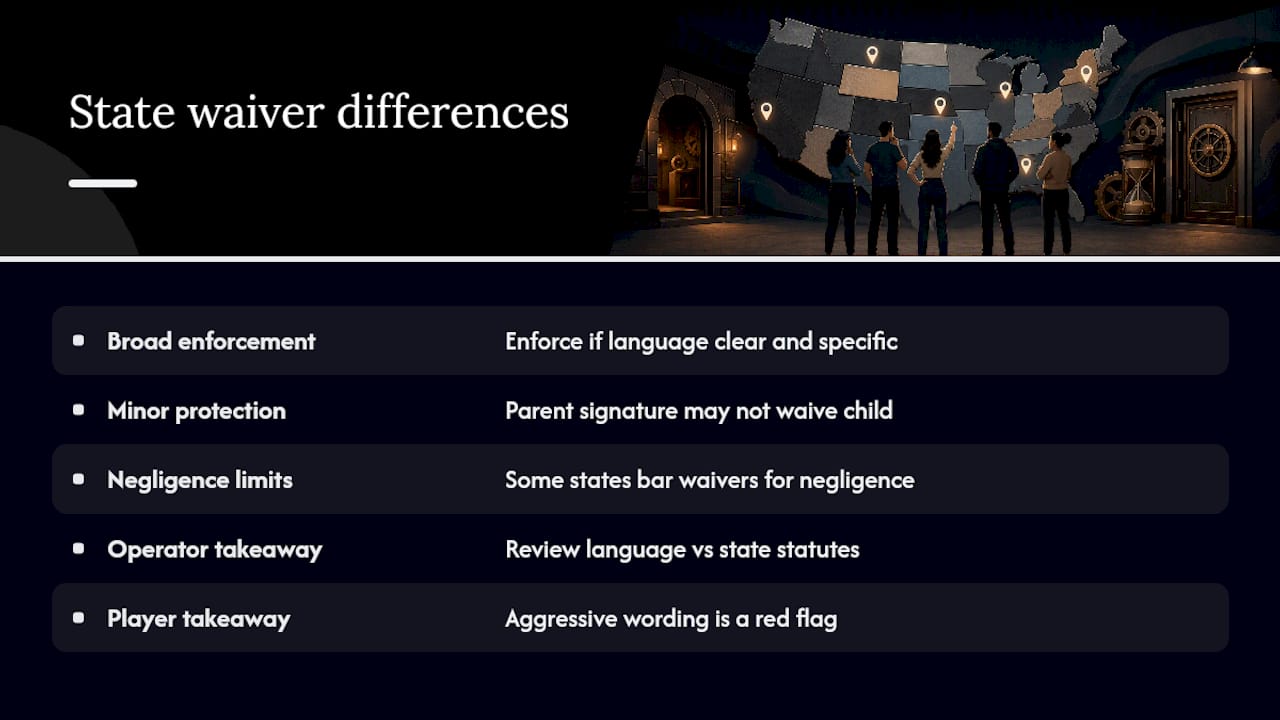
Waiver enforceability isn’t uniform across the country, and that matters if you’re comparing venues or drafting a form as an operator. Some states enforce liability waivers for recreational activities broadly, as long as the language is clear and specific. Others apply stricter scrutiny, especially where a minor’s rights are involved, since a parent’s signature can’t always waive a child’s independent legal claims in every jurisdiction.
A handful of states also limit or prohibit waivers that attempt to release a business from liability for its own negligence, even ordinary negligence rather than the gross variety, treating such clauses as against public policy. This is part of why generic, copied-from-the-internet waiver language is risky for operators: a form drafted for one state’s legal standards might not hold up in another.
For players, the practical takeaway is simpler. You’re not expected to know your state’s contract law before booking a game. But if a waiver’s language seems unusually aggressive, trying to disclaim responsibility for anything and everything, that’s often a sign the form wasn’t reviewed with local law in mind. For operators, this is exactly why a one-size-fits-all template downloaded once and never revisited is a liability of its own. Waiver language should be reviewed against the specific state’s recreational liability statutes, not assumed to transfer cleanly from one market to another.
Explaining the Waiver So Consent Is Actually Informed
A signature only reflects informed consent if the person signing actually understood what they agreed to. That’s a legal standard, not just a courtesy, and it’s one place where a lot of venues cut corners by treating the waiver as a formality to click through.
The better approach is a short verbal walkthrough at check-in, not a replacement for the written form, but a supplement to it. Staff should point out the core risks in plain language: confined spaces, physical activity, a strict time limit, and the fact that leaving early is always an option. This matters most for participants who might not read the fine print closely, including teenagers signing for themselves at venues that allow it, or non-native English speakers working through a form quickly.
Encourage questions before the game starts, not during a stressful moment mid-session. A simple prompt like “does anyone have questions about what you just signed?” takes ten seconds and catches misunderstandings before they become a problem. Group leaders booking for corporate teams or birthday parties should also confirm every individual signed their own form. One person checking a box for a dozen people doesn’t meet the same standard of informed consent, even if it’s faster at the counter.
Updating Waivers for New Rooms and New Rules
A waiver written for one room doesn’t automatically cover another. If a venue adds a room with a stronger physical component, crawling through tunnels, handling weighted props, or navigating in near darkness, the risk list needs updating to match. A generic waiver that never mentions the room’s actual hazards is exactly the kind of ambiguous language that courts tend to interpret against the operator when a dispute arises.
New regulations are the other trigger for a review. Local health and safety codes change, insurance carriers update their requirements, and state-level rules on liability waivers get revisited periodically. An operator that hasn’t reviewed its waiver language in a few years is running on outdated assumptions about what actually holds up.
Practical steps for keeping a waiver current:
- Review the risk list every time a new room or major room update launches
- Cross-check language against current state recreational liability rules, ideally with legal counsel
- Update medical attestation language if new physical elements are introduced
- Revisit media consent clauses if marketing use of footage changes (social media, promotional video, etc.)
- Confirm digital signing platforms still meet current e-signature compliance standards
None of this requires rewriting the whole form from scratch each time. It requires treating the waiver as a living document tied to the actual experience, not a static file saved once and forgotten.
Publisher Perspective: Read It, Ask, and Keep Your Copy
Most people sign escape room waivers without reading a word, and that’s the real risk, not the confined room. A waiver is a safety net, not a substitute for a venue actually running things safely. Read the risk list. Ask staff what happens if your team can’t finish or someone needs to leave early. And once you’ve signed, get a copy for your own records. Codebusters Escape Room built its process around answering these questions before the timer starts, not after.
— CodeBusters
Ready to Book? Here’s What to Expect
Codebusters Escape Room handles waivers the way this guide recommends: collected during online booking, verified at arrival, and available to you on request, not buried somewhere you’ll never see it again. You won’t be handed a clipboard of legal jargon two minutes before your game starts. The risk list, media consent, and rules clauses are all things staff will walk you through, and if you have questions about age limits, medical accommodations, or opting out of photo use, ask before you book.
Ready to pick a room and get your waiver squared away ahead of time? Book your session with Codebusters Escape Room and reach out to staff directly if you need accommodations for a minor, a medical condition, or a large group booking. Getting the paperwork sorted before you arrive means more time actually solving the room.