Group escape rooms: Unlock connection, skills, and fun
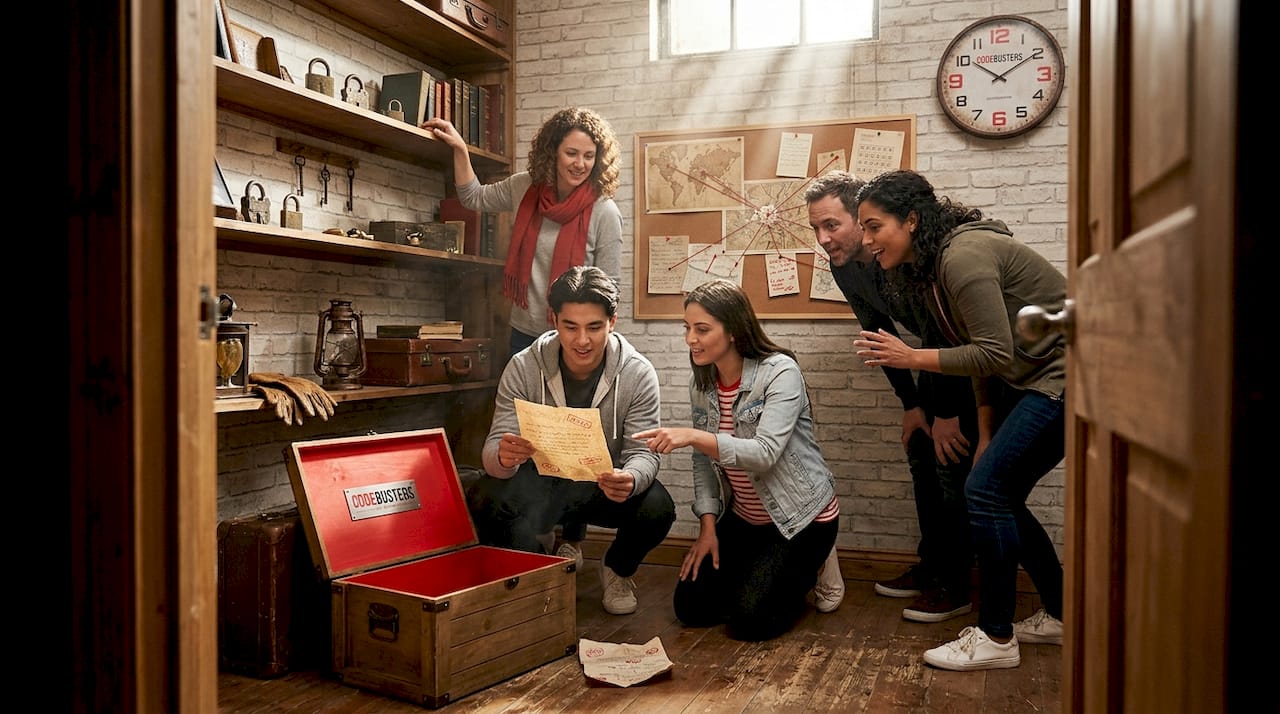
Most people walk into an escape room expecting a quick thrill and walk out with something far more valuable. Research confirms that escape room participants show significant gains in knowledge retention compared to traditional learning or entertainment formats. That finding surprises a lot of people, but it makes perfect sense once you understand what happens inside those locked rooms. Whether you are planning a family outing, a friends night out, or a corporate team-building event in Colorado Springs, escape rooms deliver lasting benefits that go well beyond the final puzzle click.
Table of Contents
- Why group escape rooms work: The science behind the fun
- Top benefits for teams, friends, and families
- Common challenges and how to overcome them
- Getting the most from your escape room experience
- Why escape rooms are more than just a trend: Our perspective
- Experience group escape room magic in Colorado Springs
- Frequently asked questions
Key Takeaways
| Point | Details |
|---|---|
| Proven team-building | Escape rooms measurably improve teamwork, communication, and group problem-solving. |
| Mental engagement boost | Participants experience higher motivation, focus, and learning than with traditional activities. |
| Versatile group benefits | Friends, families, and corporate teams all gain stronger bonds and memorable moments together. |
| Best results with planning | Choosing the right group size and discussing expectations maximizes escape room success. |
| Fun meets growth | Escape rooms offer both enjoyment and personal development for all group types. |
Why group escape rooms work: The science behind the fun
Building on the idea that escape rooms leave a lasting impact, let us look at the research on why they work so effectively for groups of all kinds.
The core appeal of escape rooms is simple: they put people in a high-stakes situation where collaboration is not optional, it is the only path forward. Psychologists point to several key mechanisms that explain why these experiences are so powerful. First, there is novelty. When your brain encounters a brand-new environment filled with unexpected puzzles, locks, and clues, it activates heightened attention and engagement. Your senses are fully switched on.
Second, there is the element of timed pressure. A countdown clock does something fascinating to group dynamics. It strips away social hesitation. People who might normally stay quiet in a meeting room suddenly speak up, delegate tasks, and make quick decisions. The clock creates urgency that mimics real-world teamwork pressures without any of the actual consequences.
Third, there is progressive reward. Every solved puzzle releases a small hit of dopamine, the brain’s feel-good chemical. That reward cycle keeps groups motivated and reinforces a sense of shared progress. Escape rooms improve long-term knowledge retention over traditional passive methods precisely because of this active, emotionally engaged participation.
“Escape rooms provide an engaging, immersive environment that promotes active learning, critical thinking, and meaningful interaction among participants.”
Systematic reviews confirm that escape rooms enhance motivation, engagement, and technical knowledge across diverse group settings. That research was originally conducted in nursing and medical education, but the underlying psychological principles apply just as clearly to a group of friends, a family, or a corporate team working through escape rooms in Colorado Springs.
Quantitative outcomes from escape room research
| Outcome measure | Improvement reported |
|---|---|
| Knowledge retention | Significantly higher vs. traditional methods |
| Motivation levels | Notably elevated throughout the experience |
| Engagement scores | Consistently high across group types |
| Communication skills | Actively practiced under real-time pressure |
| Team cohesion | Measurable gains post-experience |
Pro Tip: When choosing a room, look for designs that mix physical puzzles, logic challenges, and collaborative tasks rather than individual-only challenges. Rooms built around shared discoveries give every group member a meaningful moment to contribute.
Top benefits for teams, friends, and families
Understanding the science is great, but what does that actually look like for Colorado Springs groups? Let us break down the practical benefits for each type of group.
The benefits are not one-size-fits-all, which is part of what makes escape rooms so versatile. Corporate teams experience different advantages than families or friend groups, even inside the same room. The common thread is that everyone leaves having practiced real skills in a setting that felt nothing like work or school.
Benefits for corporate teams:
- Collaboration under pressure: Teams must divide tasks, share information quickly, and trust each other’s judgment when the clock is running. This mirrors real project dynamics far better than most office exercises.
- Leadership emergence: Natural leaders often surface organically during an escape room session. Managers frequently discover hidden strengths in team members they would never have seen in a standard meeting room.
- Communication clarity: Information must be communicated fast and accurately. Vague hints and unclear instructions cost valuable minutes, which teaches teams to value precision in real time.
- Shared victory: Completing a room together creates a genuine sense of collective achievement that lingers long after the debrief ends.
Benefits for friend groups:
- Shared challenge: Working toward a common goal strengthens bonds between friends in ways that passive entertainment simply cannot replicate.
- Laughter and creative thinking: The moments where a group completely overthinks a simple puzzle become inside jokes that last for years.
- Equal footing: Escape rooms level the playing field. A friend who is quiet at parties might be the one who cracks the critical code.
Benefits for families:
- Intergenerational problem-solving: Kids and adults approach puzzles differently. That difference becomes a genuine advantage when families pool their perspectives.
- Screen-free engagement: Escape rooms pull every family member into the same physical space, working on the same challenge, without a single screen in sight.
- Confidence building: Children who help solve puzzles alongside adults carry that confidence forward into school and social settings.
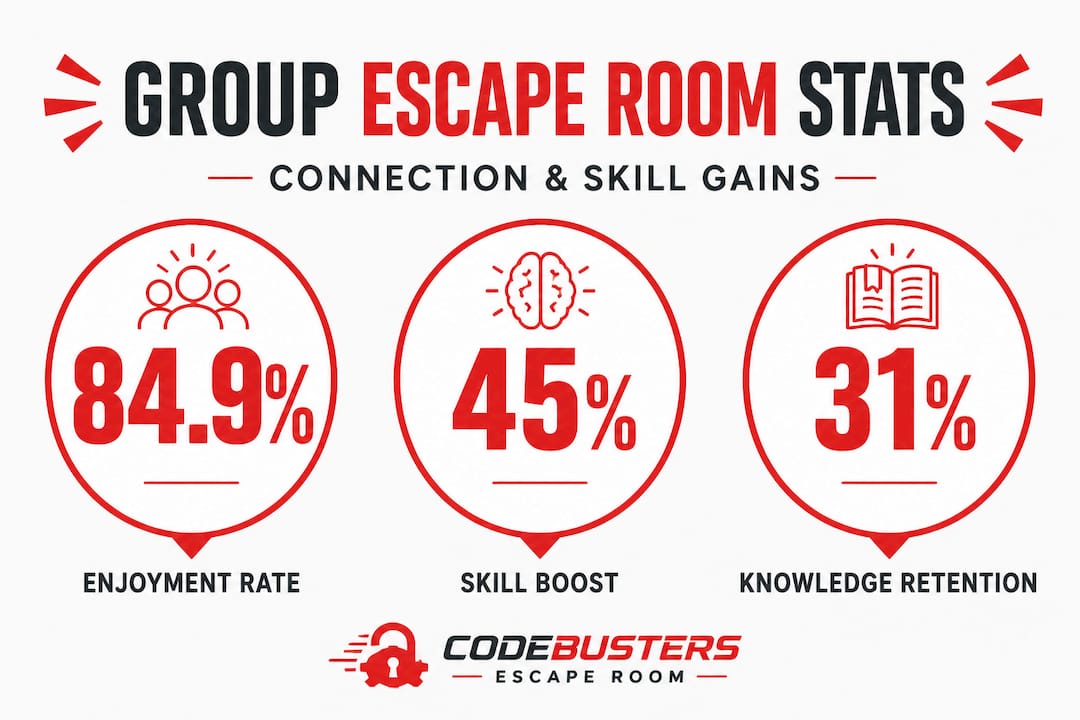
A survey of participants in group escape room experiences consistently shows remarkable outcomes. 100% of participants agreed that escape rooms actively review teamwork skills, while 98% said they practiced communication skills and 94% highlighted scene management as a core takeaway. Those numbers are extraordinary for any group activity.
“High ratings for enjoyment (84.9%) alongside strong learning and team-building outcomes demonstrate that interactive group experiences create lasting positive impact across diverse participant groups.”
The enjoyment factor matters enormously here. When people are having fun, their guards come down and they engage more authentically. That authentic engagement is exactly where real learning and real bonding happen.
Common challenges and how to overcome them
Even with impressive benefits, group escape rooms can present real challenges. Knowing what to expect helps your group navigate them smoothly and get the most out of every minute inside the room.
The most frequently reported issue is group size mismatch. Too few people and you may run out of brain power for complex multi-stage puzzles. Too many and the room becomes chaotic, with several people standing around while one person handles the main challenge. Optimal group size ranges from 2 to 12 participants. Beyond that range, coordination breaks down and the shared experience starts to fragment.
Group size and strategy comparison
| Group size | Experience type | Recommended strategy |
|---|---|---|
| 2 to 4 people | Intimate, focused | Choose moderate difficulty; assign clear roles |
| 5 to 8 people | Balanced teamwork | Split into mini-teams per puzzle cluster |
| 9 to 12 people | High energy, dynamic | Designate a coordinator to manage flow |
| 13 or more | Risk of chaos | Consider booking multiple rooms simultaneously |
The second major challenge is difficulty mismatch. A room that is too easy for your group leaves everyone feeling unchallenged. A room that is too hard creates frustration and discouragement rather than the productive pressure that makes escape rooms work. The solution is honest self-assessment before you book.
Here are the key steps to maximize your group’s performance and avoid common pitfalls:
- Discuss experience levels before booking. Find out which group members have done escape rooms before and which rooms they have completed. This one conversation can save your group from booking a beginner room they will breeze through in 20 minutes or an expert room that defeats them in the first 10.
- Assign loose roles before entering. Nominate someone to track clues and another person to manage communication with the game master. A little structure prevents the scramble where everyone crowds around the same lock.
- Communicate everything out loud. The biggest mistake groups make is spotting a clue and not mentioning it to the team. Make it a rule: if you see something, say something, every time.
- Use hints strategically. Hints are not a sign of failure. They are a built-in tool to keep momentum going. Getting stuck for 10 minutes wastes precious time when a quick hint could unlock the next 30 minutes of progress.
- Stay flexible with leadership. The person who leads one phase of the room may not be the right leader for the next. Effective groups rotate naturally based on who has the relevant insight.
Pro Tip: Always discuss your group’s prior experience and personal expectations before booking. One quick group conversation about preferred difficulty and comfort with puzzles saves time, prevents frustration, and sets everyone up for a genuinely great experience. A group sizing guide can help you choose the right room for your specific crew.
Getting the most from your escape room experience
By anticipating challenges, groups set themselves up for success. Now let us finish with practical tips to ensure you get maximum value and maximum fun from your escape room adventure.
Preparation begins before you even walk through the door. The groups that have the best experiences show up with the right mindset rather than the right puzzle skills. Curiosity, openness, and a willingness to try unconventional ideas matter far more than any previous experience.
Before the game:
- Arrive 10 to 15 minutes early so your group can settle in without feeling rushed before the countdown starts.
- Do a quick team huddle to decide on a loose communication approach. Something as simple as “call out every clue you find” sets a great tone.
- Manage expectations openly. Remind the group that winning is fun but the process is where the real value lives.
- Leave phones in lockers or pockets. Full presence makes everything better.
During the game:
- Spread out immediately and scan the entire room rather than clustering around one spot.
- Keep solved items and unsolved items physically separated so you never waste time re-examining solved puzzles.
- Actively listen when someone shares a discovery. A clue that seems irrelevant to one person might be exactly what another person needed.
- Celebrate small wins. Every opened lock deserves a quick group cheer. It keeps energy high and builds momentum.
After the game:
- Gather immediately for a brief debrief while memories are fresh. What went well? What was the breakthrough moment? What made everyone laugh?
- Acknowledge individual contributions specifically. Calling out the person who spotted the hidden compartment or cracked the cipher makes the experience feel meaningful to each member.
Interactive experiences play a larger and more important role in group learning than most people realize going in. When you treat an escape room as more than a race to the exit, it becomes something your group actually talks about for years. When planning your escape experience, think about what you want your group to take away. A little intentionality transforms a fun outing into a genuinely memorable event.
Pro Tip: Hold a 5 minute group debrief immediately after the room. Ask one simple question: “What was the moment everything clicked?” That conversation solidifies the shared memory and turns the experience into a story your group will retell for a long time.
Why escape rooms are more than just a trend: Our perspective
Here is something most guides do not tell you. The groups that get the most out of escape rooms are almost never the ones focused on winning. They are the ones who walk in genuinely curious about each other.
We have seen it play out repeatedly with groups at CodeBusters. A corporate team books a room expecting a fun team exercise. They come out talking about something they learned about a colleague they have worked with for three years. A family comes in expecting a kids activity and ends up with parents and teenagers working as genuine equals for the first time in recent memory. That shift does not happen because the puzzles are clever. It happens because the environment removes normal social scripts and replaces them with one simple shared mission.
The uncomfortable truth about most group activities is that they are passive. You sit next to people you like and watch something together. That creates pleasant associations but not real connection. Escape rooms force active interdependence, which is the actual ingredient behind genuine bonding.
Openness matters more than puzzle skills. The smartest person in the room is often the biggest obstacle if they monopolize every challenge rather than distributing the thinking. Groups that consciously invite quieter members to lead specific puzzles discover unexpected talent and create a more equitable shared experience. That kind of openness is a real-world skill, not just an escape room tip.
Our honest take is that our escape room insights always come back to the same core truth: the room is just a container. What fills it is entirely up to your group. Show up ready to be surprised by the people you are with and the room will deliver something no amount of entertainment programming can match.
Experience group escape room magic in Colorado Springs
Ready to unlock new group connections and genuine fun? Here is how you can start right here in Colorado Springs.
CodeBusters Escape Room offers a range of themed rooms designed specifically for groups of friends, families, and corporate teams. From the time-traveling puzzles of “Past to the Future” to the nostalgic mysteries of “Stranger 80’s” and the high-stakes narrative of “Flight of Deception,” each experience is crafted to challenge different strengths and create genuinely memorable shared moments. Private room bookings are available for maximum flexibility, and our veteran and family owned team brings real care and local expertise to every experience. Gift vouchers are also available for groups who want to give the gift of genuine connection. CodeBusters group escape rooms are ready for your team whenever you are.
Frequently asked questions
What group size is best for an escape room?
Groups of 2 to 12 people are ideal for a cohesive, engaging experience. Larger groups become chaotic and harder to coordinate effectively inside a single room.
How do escape rooms improve teamwork?
Escape rooms require real-time collaboration, active listening, and shared problem-solving under genuine time pressure. 100% of participants in one study agreed that escape rooms actively reviewed their teamwork and communication skills.
Are escape rooms helpful for corporate team-building?
Absolutely. Research shows escape rooms enhance motivation, engagement, and technical skills in group settings, making them one of the most effective team-building formats available.
Do escape rooms benefit families and friends, or just work teams?
Families and friend groups gain just as much as corporate teams. High enjoyment ratings of 84.9% alongside strong learning and bonding outcomes confirm that escape rooms work powerfully across all group types.
What should we do after completing an escape room?
Gather your group for a short debrief immediately after the room. Discuss what went well, celebrate your breakthrough moments, and talk through what surprised you most about how your group worked together.