Escape Room Experience: Immersive Fun for Visitors

Every traveler in Colorado Springs wants memorable moments with family and friends. Escape rooms offer more than just entertainment—they are active, immersive problem-solving experiences where collaboration and communication unlock success. Understanding what escape rooms truly involve helps you choose the right challenge for your group, ensuring an experience that builds teamwork and sparks creativity while exploring the city’s vibrant offerings.
Table of Contents
- Escape Room Experience Explained And Misconceptions
- Types Of Escape Room Challenges And Themes
- How Escape Rooms Operate For Visitors
- Booking, Group Sizes, And Team Roles
- Common Pitfalls And Tips For Success
Key Takeaways
| Point | Details |
|---|---|
| Escape Rooms Foster Collaboration | These experiences emphasize teamwork and communication, enhancing problem-solving skills among participants. |
| Misconceptions Can Alter Experience | Understanding the true nature of escape rooms can shift focus from mere entertainment to valuable learning experiences. |
| Select Appropriate Themes | Choosing the right theme based on group interests and skill levels can improve overall engagement and success rates. |
| Effective Communication is Key | Clear communication prevents duplicated efforts and fosters a more cohesive team dynamic, leading to better outcomes. |
Escape Room Experience Explained and Misconceptions
Escape rooms are far more than just a way to kill a weekend afternoon. They’re active, immersive problem-solving experiences that combine puzzle-solving, collaboration, and time pressure into one cohesive challenge. Understanding what escape rooms actually are helps you appreciate what makes them valuable for visitors like you.
What Escape Rooms Actually Are
At their core, escape rooms blend puzzle solving with collaboration and structured time constraints. You and your group work together in a themed room, solving interconnected puzzles to achieve an objective, typically “escaping” before time runs out.
They’re not random games thrown together. Each room has a narrative arc, carefully designed puzzles, and intentional difficulty progression. The experience flows logically from start to finish.
Common Misconceptions About Escape Rooms
Many visitors arrive with inaccurate expectations. Let’s clear up what escape rooms are not:
- Not just for entertainment. While fun matters, they engage executive functions like flexible thinking, problem-solving, and decision-making.
- Not about being locked in. Most facilities use standard doors; you can leave anytime. The “locked” aspect is thematic and psychological, not physical.
- Not impossible puzzles. Rooms are designed for groups of varying skill levels. Clues and hints exist to keep you progressing.
- Not solo activities. Escape rooms thrive on teamwork. Success depends on communication and dividing tasks strategically.
- Not requiring prior experience. First-timers solve rooms just as effectively as veterans when they work together.
Why This Matters for Your Visit
Misunderstanding what an escape room actually does changes your experience entirely. When you recognize that an escape room serves as an active learning environment supporting collaborative problem-solving, you approach it differently.
You focus on communication instead of racing. You celebrate discoveries together rather than competing individually. You leave having built stronger connections with your group.
This shift in perspective transforms a simple activity into something genuinely memorable. Colorado Springs visitors often report that the real reward isn’t “escaping”—it’s the shared experience of working toward something together.
Escape rooms engage your brain far beyond surface-level entertainment, building teamwork and flexible thinking that last long after the experience ends.
What to Expect During Your Experience
Here’s the typical flow when you arrive:
- Brief introduction to the room’s narrative and rules (5-10 minutes)
- Entry into the themed room with your group
- Active puzzle-solving for 60 minutes
- Either successful escape or optional extension time
- Debrief discussing what you solved and your approach
The room provides clue systems so you never feel completely stuck. Game masters monitor progress and offer assistance without spoiling solutions.
Pro tip: Assign one person to track clues and organize found items, allowing others to focus on solving—this simple role division dramatically improves your success rate and reduces frustration.
Types of Escape Room Challenges and Themes
Escape rooms aren’t all the same. Some focus on solving cryptic codes while others emphasize physical exploration or narrative discovery. Understanding the different challenge types and themes helps you choose an experience that matches what excites your group.
The Range of Puzzle Types
Escape room puzzles span physical, digital, and hybrid forms, each requiring different skills and approaches. This variety ensures that different visitors find something engaging.
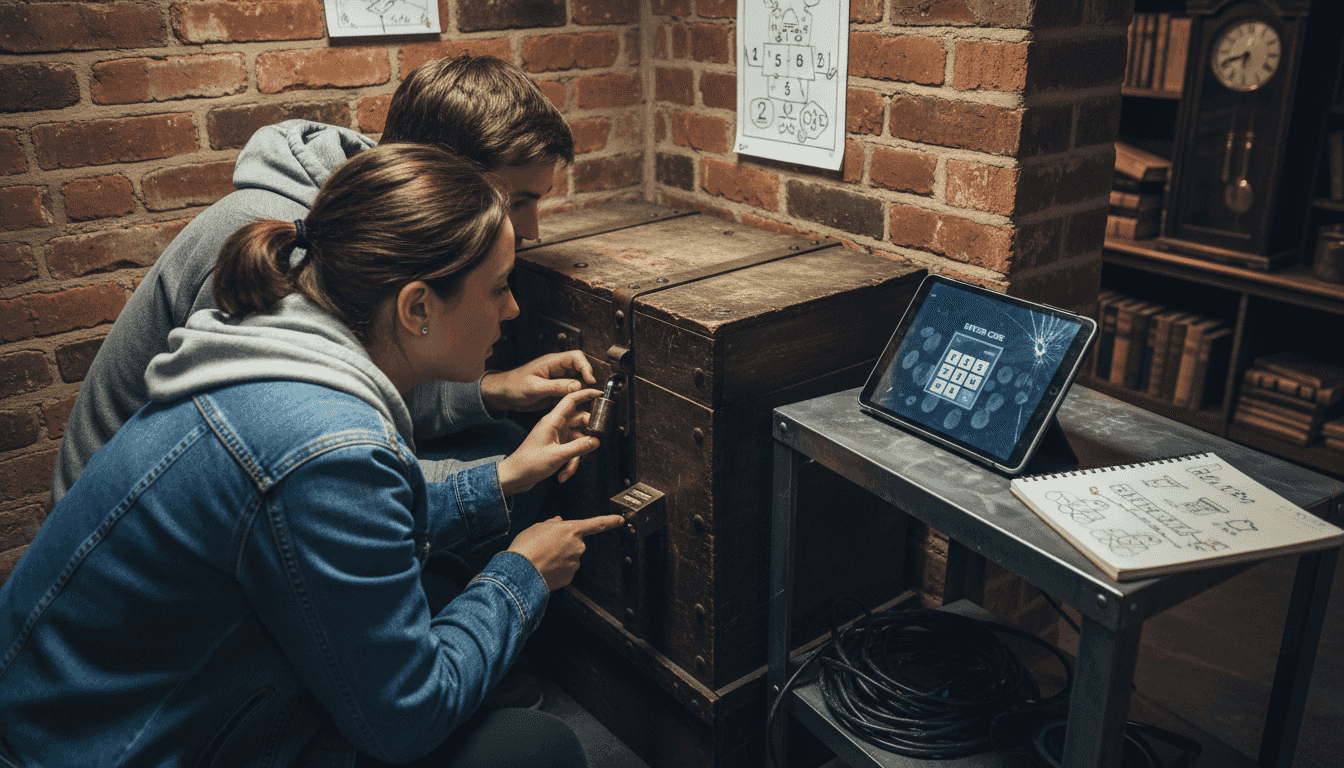
Physical puzzles might involve finding hidden objects, manipulating locks, or arranging items to reveal clues. Digital puzzles use computers, keypads, or light-based mechanisms. Hybrid puzzles blend both—perhaps a physical object that unlocks digital content.
Popular Theme Categories
Themes provide the narrative context that makes escape rooms memorable. Colorado Springs visitors encounter a wide variety:
- Mystery and detective themes. Solve a crime, gather evidence, and catch the culprit before time expires.
- Adventure and exploration. Navigate ancient temples, lost treasure vaults, or remote islands.
- Horror and suspense. Survive eerie scenarios involving supernatural elements or psychological tension.
- Sci-fi and futuristic. Break out of space stations, laboratories, or technologically advanced facilities.
- Historical and period-based. Experience specific eras—Victorian mansions, prohibition speakeasies, or Wild West saloons.
- Fantasy and magical worlds. Enter wizarding schools, enchanted forests, or dragon lairs.
Themes aren’t just decoration. They shape how puzzles work, what atmosphere surrounds you, and how your group approaches challenges together.
To help you select the best escape room experience, here is a comparison of popular escape room themes and the main skills they develop:
| Theme Category | Key Skills Developed | Ideal For |
|---|---|---|
| Mystery/Detective | Communication, deduction | Beginners, team players |
| Adventure/Exploration | Observation, creativity | Families, first-timers |
| Horror/Suspense | Stress management, focus | Experienced groups |
| Sci-fi/Futuristic | Logic, tech literacy | Puzzle enthusiasts |
| Historical/Fantasy | Imagination, storytelling | History buffs, storytellers |
How Themes Connect to Difficulty Levels
Theme selection often correlates with challenge intensity. Beginners typically thrive in adventure or mystery themes with straightforward logic puzzles. Experienced groups tackle horror or complex puzzle-heavy scenarios that demand deeper thinking.
Your theme choice affects what cognitive and social skills you’ll develop. A team-focused mystery theme emphasizes communication. A solo-heavy adventure emphasizes independent problem-solving before sharing discoveries.
Challenge Difficulty Progressions
Well-designed rooms follow a learning curve. Early puzzles teach you how the room works. Mid-game puzzles build on those lessons. Final puzzles demand synthesizing everything you’ve learned.
This progression keeps you engaged without overwhelming frustration. You feel capable, then challenged, then triumphant.
The best escape room experiences match your group’s skill level—not so easy that you’re bored, not so hard that you’re stuck guessing randomly.
Choosing What Fits Your Group
Consider these factors when selecting:
- Experience level. First-timers benefit from beginner-friendly themes with clear puzzle logic.
- Interests. Does your group prefer puzzles, storytelling, action, or a mix?
- Time availability. Some rooms demand 45 minutes; others need the full 60.
- Group size. Certain themes work better with 2-4 people; others shine with larger groups.
Pro tip: If your group has mixed experience levels, choose a theme emphasizing teamwork over individual puzzle-solving—this prevents experienced players from dominating while newcomers watch.
How Escape Rooms Operate for Visitors
Escape rooms follow a structured format designed to maximize engagement while keeping everyone on track. Knowing how they work removes anxiety and helps you approach the experience with confidence.
The Complete Experience Flow
Your escape room visit follows distinct phases, each serving a specific purpose. Understanding this timeline helps you prepare mentally and physically.
First comes the briefing phase. Staff explains the room’s narrative, rules, and how to request hints. You’ll learn about emergency exits and any physical limitations. This typically lasts five to ten minutes and sets expectations clearly.
Then you enter the timed gameplay phase. The clock starts, and you have 60 minutes to solve puzzles and escape. This is where collaboration and problem-solving create the core challenge.
After time expires or you escape, the debriefing phase begins. Staff discusses what you solved, which puzzles stumped you, and how your group approached challenges. This reflection deepens the experience.
How Puzzles and Technology Work Together
Modern escape rooms blend traditional mechanics with advanced technology. Physical puzzles might involve hidden compartments, locks requiring specific combinations, or objects you manipulate to reveal clues.
Technological effects and virtual reality enhance visitor engagement by creating immersive atmospheres. Rooms might feature:
- Electronic locks activated by solving earlier puzzles
- Projection mapping that reveals hidden messages
- Sound effects that trigger atmosphere changes
- Motion sensors that activate new elements
- Digital interfaces requiring codes or sequences
The balance between physical and digital creates variety. You’re never solving the same puzzle type consecutively.
Monitoring and Hint Systems
Game masters watch your progress through cameras without interfering. If you’re stuck, you can request hints through an intercom system.
Hints range from subtle nudges to direct solutions. Early hints guide you toward areas or mechanisms you might have missed. Later hints offer direct answers if frustration builds. This system keeps momentum flowing without spoiling discoveries.
The Design Behind Flow and Difficulty
Well-designed rooms create balanced difficulty progressions. Early puzzles teach you the room’s logic and mechanics. Middle puzzles demand applying those lessons to new situations. Final puzzles synthesize everything you’ve learned.
This intentional structure prevents two extremes: boredom from tasks too simple, and despair from impossible challenges. You feel capable, then stretched, then triumphant.
Great escape room design feels invisible—players feel challenged but never unfairly stuck, progressing steadily toward the finale.
Group Dynamics During Gameplay
Your group’s communication directly affects success. Players naturally divide tasks: some search areas, others track clues, another solves logic puzzles.
Effective groups:
- Share discoveries immediately instead of hoarding clues
- Divide responsibilities based on strengths
- Ask for help without ego or hesitation
- Track attempted solutions to avoid repeating them
- Stay vocal about observations and theories
Pro tip: Assign one person as “clue tracker” who organizes and announces all found items and solved puzzles—this prevents duplicate efforts and keeps everyone oriented.
Booking, Group Sizes, and Team Roles
Planning your escape room visit starts with finding the right group size and understanding how roles distribute responsibilities. These decisions directly impact whether your experience feels smooth or chaotic.
Ideal Group Size for Your Visit
Escape rooms typically accommodate 3 to 8 participants to optimize communication and engagement. Smaller groups feel more intimate but place greater puzzle-solving pressure on each person. Larger groups offer more perspectives but risk communication breakdowns.
The sweet spot for most visitors falls between 4 and 6 people. This size balances diverse skills, prevents crowding, and maintains efficient communication. You have enough people to divide tasks without losing coordination.
Smaller groups of 2 to 3 work if everyone has strong puzzle-solving confidence. Larger groups of 7 to 8 succeed only with clear role assignment and designated communication leaders.
Understanding Team Roles
Team roles such as leader, communicator, and checker promote coordinated action and maximize group efficiency. You don’t need a manager imposing roles—they emerge naturally. Understanding common roles helps you recognize what your group needs.
Key roles include:
- The leader. Takes charge, keeps group on task, manages time awareness, and advocates for hints when stuck.
- The communicator. Announces discoveries, updates group on findings, ensures no one hoards clues.
- The checker. Verifies attempted solutions, tracks what’s been tried, prevents repeated failures.
- The searcher. Systematically explores the room, finds hidden objects, manipulates physical mechanisms.
- The puzzle solver. Focuses on logic puzzles, codes, and pattern recognition while others handle exploration.
Most people naturally gravitate toward one or two roles based on strengths. You don’t need to formally assign them.
Below is a summary of common escape room team roles and how each contributes to overall group success:
| Role | Primary Responsibility | Benefit to Team |
|---|---|---|
| Leader | Organizes tasks and timing | Keeps group focused |
| Communicator | Shares information and clues | Enhances collaboration |
| Checker | Verifies solutions and progress | Reduces repeated errors |
| Searcher | Finds hidden objects/clues | Expands available information |
| Puzzle Solver | Handles complex logic puzzles | Accelerates puzzle progression |
Making Your Booking
Booking an escape room visit requires selecting date, time, room theme, and group size. Most facilities let you reserve through their website or phone.
Consider these timing factors:
- Weekday afternoons offer shorter wait times before gameplay
- Weekend slots fill faster, especially for beginner-friendly themes
- Back-to-back bookings sometimes offer discounts
- Allow 15 to 20 minutes before your start time for arrival and briefing
Book in advance when possible. Popular time slots disappear weeks ahead, especially during school breaks or tourist season in Colorado Springs.
Group Composition Matters
Who you invite affects dynamics significantly. Groups mixing experience levels require intentional role distribution. Avoid putting all beginners together unless it’s a beginner-focused room.
Inclusive groups where everyone contributes succeed more than groups where one or two people dominate.
The best escape room groups have clear roles, open communication, and genuine enthusiasm for solving together rather than competing.
Pre-Game Preparation
Arrive 10 minutes early. This cushion prevents rushing and lets you settle into the space. Discuss roles and expectations briefly before entering the room.
If your group hasn’t worked together before, assign roles intentionally rather than assuming they’ll emerge naturally.
Pro tip: Before booking, confirm your group’s experience levels with everyone invited—then choose a room difficulty that challenges without overwhelming, and assign the leader role to someone comfortable managing group dynamics.
Common Pitfalls and Tips for Success
Most escape room struggles stem from preventable mistakes. Knowing what goes wrong helps you sidestep frustration and maximize your chances of success.
Mistakes That Cost You Time
The biggest pitfall is poor communication. Players solve puzzles independently without sharing discoveries, leading to duplicated effort. One person solves a code while another searches for the same answer elsewhere.
Maintaining open communication and embracing failure as a learning mechanism transforms your approach. Announce every find immediately. Share theories before testing them. Ask for help without hesitation.
Another common mistake is ignoring clues or hints. Players either miss them entirely or refuse to request them due to pride. Hints exist to keep momentum flowing, not to indicate failure.
Time Management Errors
Many groups waste the first 10 minutes exploring randomly instead of systematically. Without direction, you backtrack and re-search areas you’ve already covered.
Start by understanding the room’s layout and dividing sections strategically. Assign each person or pair a specific area. This prevents overlap and ensures comprehensive exploration.
Another timing mistake is getting stuck on one puzzle for 20 minutes. Sometimes walking away and returning with fresh eyes reveals solutions. Ask for a hint before frustration builds.
Stress and Team Dynamics
Managing stress and reflecting on team dynamics improves problem-solving strategies significantly. When frustration rises, tension spreads through the group. Someone snaps, communication breaks down, and collaboration collapses.
Recognize when stress levels spike. Take a breath. Request a hint. Shift focus to a different puzzle. Your mindset directly affects performance.
Groups that laugh at failures outperform groups that blame. Celebrate small victories. Treat setbacks as learning opportunities rather than personal failures.
Strategies for Success
Proven approaches separate successful teams from struggling ones:
- Communicate every discovery. No silent puzzle-solving.
- Organize and track clues. One person manages the running list.
- Divide the room logically. Search systematically, not randomly.
- Request hints strategically. When stuck, ask rather than spinning your wheels.
- Stay positive. Humor and encouragement keep energy high.
- Think outside the box. Escape rooms often reward lateral thinking over obvious solutions.
The difference between success and failure usually comes down to communication, not puzzle difficulty—teams that talk win more often than silent teams.
Learning From Your Experience
After your session, debrief honestly. What worked? What slowed you down? Which puzzles stumped you?
This reflection builds skills for your next escape room. You’ll naturally improve communication, develop faster pattern recognition, and make strategic decisions more quickly.
Pro tip: During gameplay, designate one person to gently redirect the group if focus scatters—this prevents the common pitfall of everyone solving different puzzles simultaneously without coordination.
Discover Unforgettable Teamwork and Thrills with Codebusters Escape Room
Escape rooms challenge your group to embrace collaboration, creative problem-solving, and clear communication—exactly what the article highlights as the keys to an immersive and rewarding experience. If you want to transform your visit into more than simple entertainment but a true active learning adventure with engaging narratives and thoughtfully designed puzzles choose Codebusters Escape Room in Colorado Springs. Offering unique themed rooms like “Past to the Future” and “Flight of Deception” that cater to different group sizes and skill levels you can experience exactly the kind of balanced challenge and shared excitement discussed in the article.
Don’t wait to turn your escape room visit into a memorable opportunity to build stronger connections and sharpen your team’s skills. Visit Codebusters Escape Room now to explore all our experiences and secure your booking. Learn more about how we craft immersive puzzle adventures on our official website and get ready for an experience that goes beyond ordinary fun. Are you ready to unlock your team’s potential today?
Frequently Asked Questions
What should I expect in an escape room experience?
You can expect a brief introduction to the room’s narrative and rules, followed by 60 minutes of active puzzle-solving with your group. There will also be a debriefing session to discuss your experience after the game.
Are escape rooms suitable for beginners?
Yes, escape rooms are designed for participants of all skill levels. Beginners can easily participate and enjoy the experience, especially in rooms that focus on teamwork and have beginner-friendly puzzles.
How do teamwork and communication affect success in escape rooms?
Effective communication and collaboration are crucial in escape rooms. Teams that share discoveries, divide responsibilities, and support one another tend to solve puzzles more successfully and enhance the overall experience.
What types of puzzles can I expect in an escape room?
Expect a variety of puzzles that may include physical challenges, digital tasks, and hybrid forms. These puzzles require different skills such as logic, deduction, and creativity, making the experience engaging for everyone.