Escape rooms for families: 30% better teamwork in 2026

Many families assume escape rooms are too challenging or niche, suited only for teens and adults seeking intense brain teasers. Yet the reality is far more inclusive. Escape rooms designed for families offer immersive experiences that naturally adapt to diverse ages and skill sets, creating perfect environments for shared adventure, improved communication, and genuine fun. This guide reveals how escape rooms build exceptional teamwork, what to look for when choosing the right experience, and how your family can unlock lasting memories and stronger bonds through these interactive challenges.
Table of Contents
- What Makes Escape Rooms Ideal For Families
- How Escape Rooms Promote Teamwork And Communication
- Cognitive And Psychological Benefits Of Escape Rooms
- Selecting The Right Escape Room For Your Family
- Common Misconceptions About Escape Rooms For Families
- Practical Tips For A Successful Family Escape Room Experience
- Unlocking Family Fun And Learning Through Escape Rooms
- Experience Unforgettable Family Bonding At CodeBusters Escape Room
- FAQ
Key takeaways
| Point | Details |
|---|---|
| Communication boost | Escape rooms improve family communication skills by approximately 30% through collaborative puzzle solving. |
| Engagement power | Immersive story themes increase participation and cooperation by around 35% across all ages. |
| Inclusive design | Age-appropriate rooms starting from 8 years old ensure every family member actively contributes. |
| Cognitive growth | Families show 25% improvement in real-time problem-solving abilities after escape room participation. |
| Strategic selection | Private bookings and adjustable difficulty maximize comfort and success for diverse family groups. |
What makes escape rooms ideal for families
Escape rooms transform family time from passive viewing into dynamic, hands-on adventure. Unlike movie theaters or restaurants where everyone sits quietly, escape rooms demand active engagement from every participant regardless of age or experience level. Each family member searches for clues, solves puzzles, and contributes unique perspectives to shared goals.
The immersive storytelling environments create natural excitement that bridges generation gaps. Whether exploring a time travel mystery or unraveling a space station crisis, compelling narratives capture imaginations across age groups. These shared adventures generate conversation topics and inside jokes that extend well beyond the 60-minute experience.
Escape rooms also promote teamwork in genuinely low-pressure settings. Families collaborate without external judgment, working together toward common objectives. The format naturally encourages:
- Open communication as members share discoveries and theories
- Mutual support when puzzles feel challenging
- Celebration of individual strengths and creative thinking
- Practice with time management and prioritization skills
This combination creates memorable bonding opportunities while building practical life skills your family will use for years.
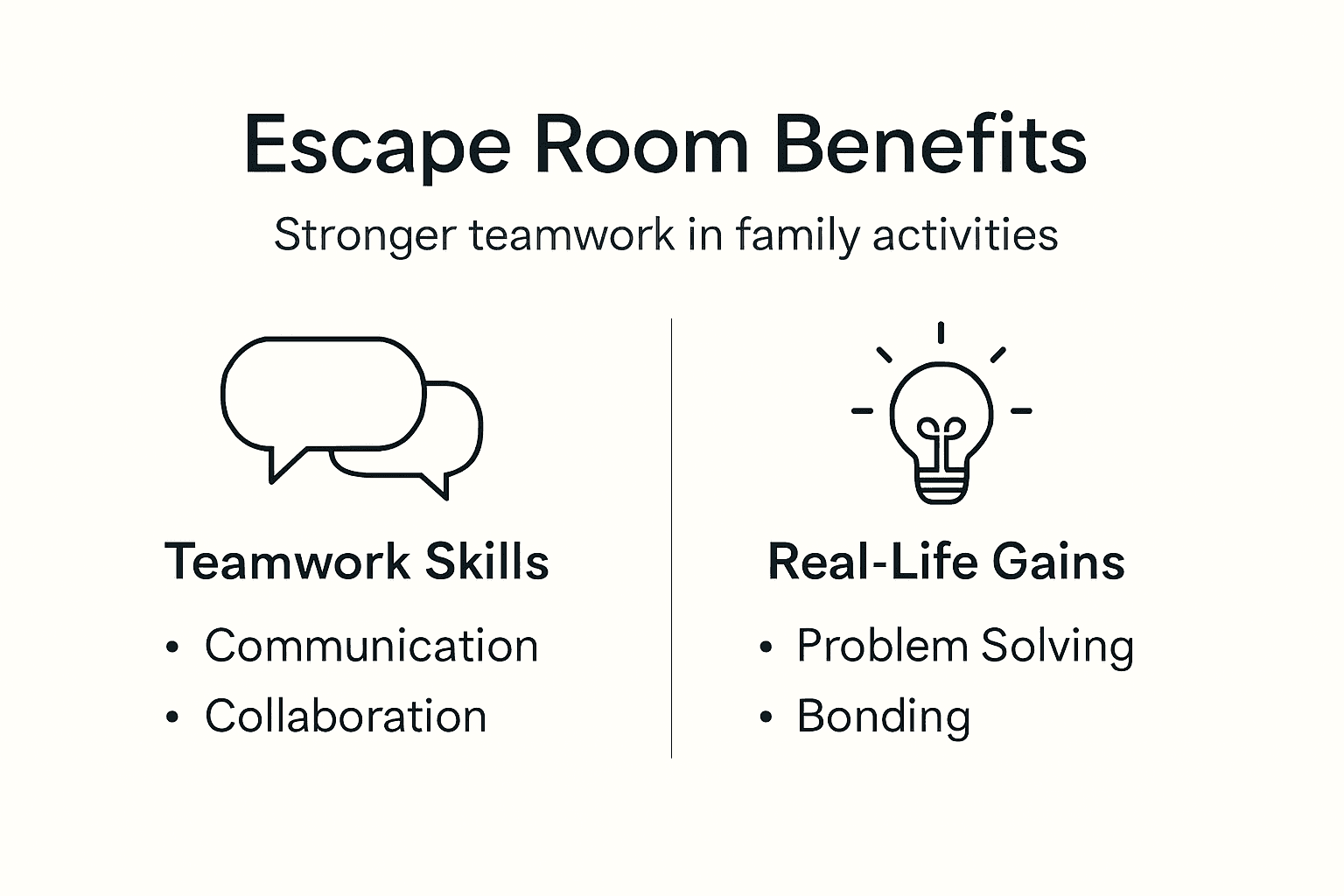
How escape rooms promote teamwork and communication
Within minutes of entering an escape room, families naturally organize themselves into effective teams. Some members gravitate toward physical puzzles, others excel at pattern recognition, and different individuals shine with logical deduction. This organic role distribution lets everyone contribute meaningfully based on genuine strengths rather than prescribed assignments.
The collaborative environment fundamentally changes how families interact. Parents and children become equal partners in problem solving, creating balanced dynamics where younger members often spot crucial clues adults overlook. This mutual respect builds confidence in children while reminding parents to value fresh perspectives.
Immersive narratives increase participant engagement and teamwork effectiveness by approximately 35%, transforming abstract cooperation into concrete shared experiences. The time constraint adds healthy urgency without creating excessive stress, encouraging families to communicate efficiently and stay organized.
“Our kids surprised us by taking charge of entire puzzle sequences. We learned to trust their instincts and celebrate their unique problem-solving approaches.”
Successful escape room families follow this communication pattern:
- Announce every discovery immediately to keep everyone informed
- Think aloud to share reasoning and invite input
- Ask for help without hesitation when stuck
- Listen actively to suggestions from all family members
- Celebrate small wins to maintain positive momentum
Pro Tip: Before starting, agree on a simple signal like raising a hand when someone finds something important. This prevents voices from getting lost in excitement and ensures critical information reaches the whole team.
When selecting the right escape room for your family, consider how the theme and difficulty level will support these natural teamwork patterns.
Cognitive and psychological benefits of escape rooms
Escape rooms engage executive brain functions in ways typical family activities rarely achieve. Your family practices rapid decision making, strategic thinking, and cognitive flexibility simultaneously. When one approach fails, you quickly pivot to alternative strategies, building mental adaptability that transfers to school, work, and daily problem solving.
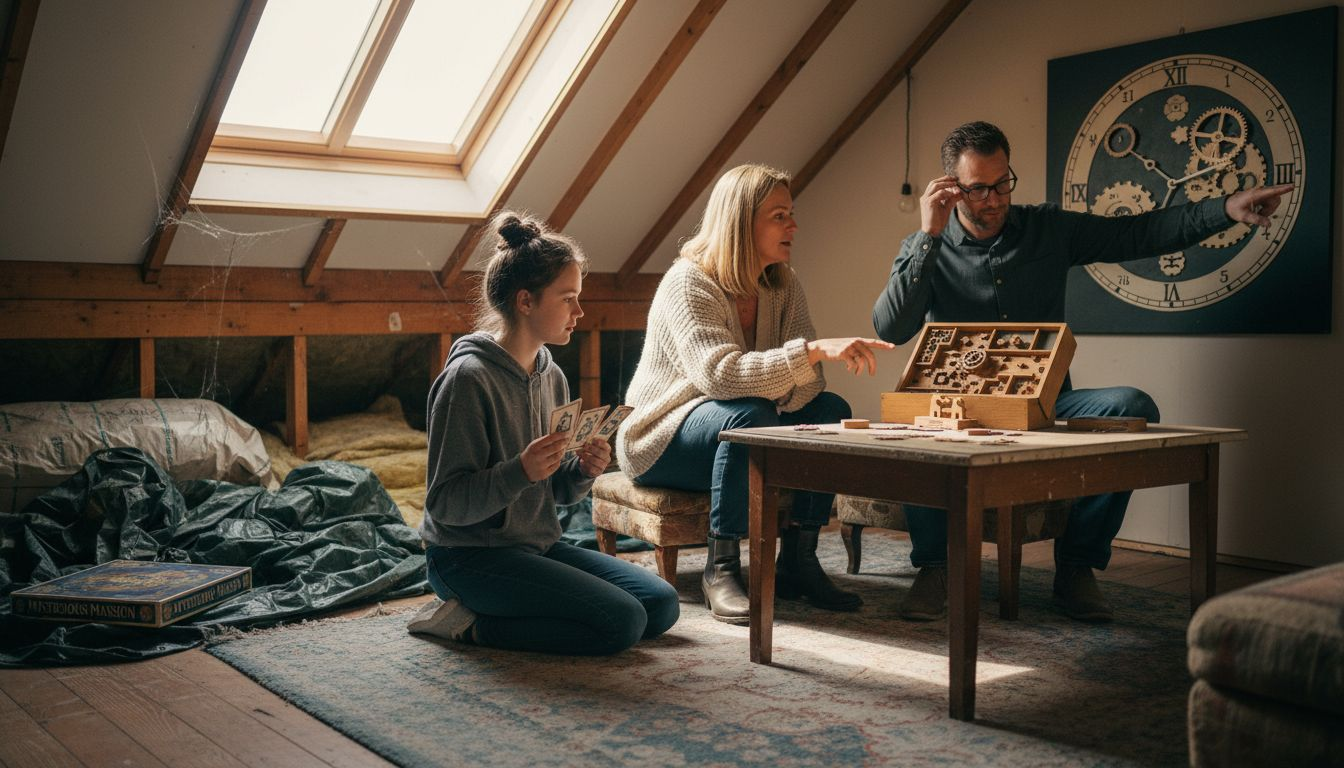
Research demonstrates tangible cognitive improvements. Studies show a 25% improvement in participants’ real-time problem-solving ability after escape room participation, reflecting enhanced pattern recognition, logical reasoning, and creative thinking under pressure.
| Cognitive Benefit | Impact on Families | Real-World Application |
|---|---|---|
| Decision making speed | 20-30% faster consensus | Better cooperation during daily choices |
| Creative problem solving | 25% improvement | Enhanced academic and work performance |
| Working memory | Stronger information retention | Improved multitasking abilities |
| Stress management | Positive pressure response | Healthier reactions to deadlines |
The immersive challenge also triggers neurochemical responses that strengthen family bonds. Successfully solving puzzles together releases dopamine and oxytocin, the same bonding hormones active during quality family time. These positive associations create lasting emotional connections to collaborative achievement.
Younger family members particularly benefit from safe environments where mistakes become learning opportunities rather than failures. When a theory proves wrong, the family simply adjusts and continues, modeling healthy resilience and growth mindset.
Pro Tip: After completing an escape room, discuss which puzzles challenged different family members most. This reflection deepens learning and helps everyone appreciate diverse thinking styles.
Selecting the right escape room for your family
Choosing the appropriate escape room makes the difference between frustration and triumphant fun. Start by evaluating age recommendations carefully. Most family-friendly rooms accommodate participants 8 years and older, but puzzle complexity varies significantly between venues and specific rooms.
Theme selection matters more than families initially realize. Abstract or horror-based scenarios might alienate younger members or those with specific sensitivities. Look for adventure, mystery, or comedy themes with broad appeal. Time travel, treasure hunts, and detective stories typically engage diverse age groups effectively.
Private booking options provide significant advantages for families. You control the pace, take breaks if needed, and communicate freely without concern for strangers’ expectations. Many families report more relaxed, enjoyable experiences when playing exclusively with their own group.
| Room Feature | Why It Matters | What to Look For |
|---|---|---|
| Adjustable difficulty | Prevents early frustration | Hint systems with varying detail levels |
| Diverse puzzle types | Engages different skills | Mix of physical, logic, and creative challenges |
| Group size capacity | Comfortable participation | Rooms sized for your exact family count |
| Theme accessibility | Universal appeal | Stories interesting across age ranges |
When researching CodeBusters escape room options, review each theme’s description and difficulty rating. Consider these selection factors:
- Minimum age recommendations and supervision requirements
- Puzzle complexity relative to your youngest participant
- Physical demands like crawling or reaching high spaces
- Story content and potential intensity levels
- Average success rates for first-time family groups
Contact venues directly with specific questions about your family’s composition. Quality escape room providers gladly offer guidance to ensure positive experiences that match your group’s capabilities.
Common misconceptions about escape rooms for families
Several persistent myths discourage families from trying escape rooms despite their accessibility and benefits. Understanding the reality helps you approach these experiences with appropriate expectations and confidence.
Myth: Escape rooms are too difficult for children. Family-oriented escape rooms specifically design puzzles for mixed-age groups starting around 8 years old. Challenges scale to accommodate developing reasoning skills while still engaging adults. Many rooms include multiple puzzle tracks so different family members can work on age-appropriate tasks simultaneously.
Myth: Only one or two people actually solve everything. Well-designed escape rooms require input from multiple participants. Puzzles intentionally demand collaboration, with some requiring physical teamwork and others needing simultaneous work in different areas. Dominant personalities cannot monopolize success when the format demands genuine group effort.
Myth: Escape rooms are just entertainment without lasting value. The skills families practice translate directly to real-world situations. Improved communication, collaborative problem solving, and stress management under time pressure all benefit school projects, workplace teamwork, and family decision making. Many educators recognize escape rooms as powerful experiential learning tools.
Myth: You need special knowledge or abilities. Escape rooms provide all necessary information within the room itself. Success depends on observation, creativity, and teamwork rather than outside expertise. Families with zero escape room experience regularly complete challenges and report high satisfaction.
These misconceptions often stem from media portrayals or isolated negative experiences at poorly designed venues. Quality family escape rooms prioritize inclusive fun and achievable challenges over extreme difficulty.
Practical tips for a successful family escape room experience
Maximize your family’s enjoyment and success with strategic preparation and smart in-game practices. Small adjustments create significantly better experiences.
-
Arrive 15 minutes early to use restrooms, secure belongings, and receive thorough briefings without rushing. Starting calm beats starting stressed.
-
Review basic escape room concepts with younger members beforehand. Explain that every item matters, nothing requires force, and asking for hints is encouraged.
-
Establish communication ground rules before entering. Everyone speaks up immediately when finding something, and all ideas get respectful consideration.
-
Divide the space initially so family members search different areas, then reconvene to share findings. This prevents clustering and maximizes coverage.
-
Create a central collection point for items and clues. Designate one family member as organizer to prevent losing track of important pieces.
-
Use hints strategically rather than struggling endlessly. Most venues offer tiered hint systems that nudge without spoiling. Taking hints maintains momentum and prevents frustration from derailing fun.
Pro Tip: After escaping (or time expiring), spend 10 minutes debriefing as a family. Discuss favorite moments, surprising discoveries, and what you learned about working together. This reflection cements the experience and strengthens bonds.
Consider your family’s energy levels and schedule escape rooms when everyone feels alert. Morning and early afternoon sessions often work better for families with younger children than late evening slots. Some families benefit from light snacks beforehand to maintain focus and positive attitudes.
For additional planning group accommodation tips when organizing escape room outings with extended family or multiple families, advance coordination ensures smooth logistics.
Unlocking family fun and learning through escape rooms
Escape rooms represent more than entertainment trends. They provide structured opportunities for families to build essential teamwork and communication skills in genuinely engaging contexts. The 30% improvement in family communication and 25% boost in problem-solving abilities reflect real cognitive and social development.
Colorado Springs families seeking meaningful bonding experiences beyond typical outings discover lasting value in these immersive challenges. Properly selected escape rooms create shared adventures that generate inside jokes, strengthen relationships, and build confidence in collaborative abilities.
The combination of age-appropriate difficulty, compelling storytelling, and natural role distribution makes escape rooms uniquely effective for diverse family compositions. When you prioritize inclusive themes and leverage private booking options, every family member contributes meaningfully to shared success. These experiences teach valuable lessons about communication, resilience, and creative problem solving that extend far beyond the escape room walls.
Experience unforgettable family bonding at CodeBusters Escape Room
Ready to unlock extraordinary family memories while building real teamwork skills? CodeBusters escape rooms in Colorado Springs offer thoughtfully designed experiences perfect for families with children ages 8 and up. Our immersive themed rooms like Past to the Future and Stranger 80’s combine compelling stories with age-appropriate challenges that engage every family member.
We specialize in private family bookings that let you explore at your own pace with personalized support from our experienced game masters. Our veteran and family-owned business understands what makes family adventures successful. Book your CodeBusters experience today and discover why families consistently rate us among Colorado Springs’ top entertainment destinations for meaningful connection and unforgettable fun.
FAQ
Are escape rooms suitable for children under 8 years old?
Most family escape rooms recommend ages 8 and up because puzzle complexity requires developed reasoning skills. Younger children may struggle with abstract concepts and sustained focus, potentially feeling frustrated rather than engaged. Some venues offer specifically designed rooms for ages 6-7 with parental participation.
How can we ensure all family members contribute during the escape room?
Encourage role diversity by assigning tasks matching individual strengths like physical puzzles, pattern recognition, or organization. Actively facilitate communication by asking quieter members for input and celebrating every contribution equally. Designate a family member to ensure everyone stays included and informed throughout the experience.
What if our family doesn’t solve the escape room in time?
Focus on teamwork quality and fun rather than completion as the primary goal. Each attempt strengthens problem-solving skills and family cooperation regardless of outcome. Many families intentionally try progressively harder rooms, treating non-completion as motivation to improve rather than failure.
Can we book a private escape room session just for our family?
Many venues including CodeBusters offer private family bookings exclusively for your group. This option provides relaxed environments without strangers, personalized hint assistance, and flexible pacing that accommodates your family’s specific needs and comfort levels.
Do we need previous escape room experience to enjoy a family session?
No prior experience is necessary for family-friendly escape rooms. Venues design introductory experiences specifically for first-time participants, and game masters provide thorough briefings. Many families report their first escape room as their most memorable because everything feels fresh and exciting.
Recommended
- CodeBusters Escape Room | Escape Rooms | Colorado Springs
- Team Building za Podjetja - Golden Gloves Gym
- Cómo preparar reunión familiar exitosa en Barcelona: 25% más satisfacción