Escape Rooms for Large Groups: Enhancing Teamwork

Every team leader knows the challenge of uniting a large group, especially when routine meetings leave energy flat and collaboration hidden. Escape rooms offer a powerful shift for Colorado Springs corporate teams by turning teamwork into a high-stakes, hands-on experience where communication, decision-making, and leadership are put to a real test. With immersive puzzles under a ticking clock, these experiences deliver authentic insights and memorable growth that typical training cannot match. Collaborative problem-solving becomes the centerpiece of your next group session.
Table of Contents
- Escape Rooms For Large Groups Explained
- Popular Room Styles And Formats
- How Group Play Boosts Collaboration
- Logistics, Booking, And Room Selection
- Key Planning Factors And Pitfalls To Avoid
Key Takeaways
| Point | Details |
|---|---|
| Team Dynamics Reveal Strengths | Escape rooms expose real communication patterns under pressure, highlighting strengths and areas for improvement in team dynamics. |
| Optimal Group Size Matters | For effective participation, groups of 10-30 require multiple room bookings to avoid chaos and enhance collaboration. |
| Format Selection Is Key | Choose physical rooms for maximum engagement and learning; hybrid and digital formats suit distributed teams better. |
| Advance Planning Essential | Booking in advance ensures appropriate room selection, group engagement, and beneficial team experiences during activities. |
Escape Rooms for Large Groups Explained
Large group escape rooms are structured team-building experiences where your group solves puzzles and challenges together to escape a themed room within a set time limit. Unlike casual entertainment, they’re designed specifically to reveal how your team communicates, makes decisions, and handles pressure when it counts. For corporate teams in Colorado Springs, these rooms offer a real-world simulation of problem-solving under constraints.
What Makes Them Work for Teams
Escape rooms blend puzzle-solving with time pressure and narrative immersion, creating an environment where individual skills matter far less than collective strategy. Your team can’t succeed through individual brilliance alone—everyone must contribute.
Key elements that drive teamwork improvement:
- Communication pressure: Limited time forces explicit instructions instead of assumptions
- Distributed expertise: Different puzzles require different skill sets, so everyone has a moment to lead
- Visible accountability: Mistakes become obvious immediately; success requires transparency
- Shared stakes: Everyone succeeds or fails together—no hiding underperformance
Real teams discover their actual communication patterns under pressure, not in surveys or hypothetical scenarios.
How Large Groups Actually Perform
Team-based recreational activities develop collaboration through varied puzzle design and measurable performance outcomes. Larger groups (12-30 people) typically need multiple simultaneous room bookings to function effectively, as coordination becomes chaotic above 8-10 people per room.
What happens in your group:
- Initial confusion as people orient to the space and puzzle types
- Natural leaders emerge as time pressure increases
- Communication either clarifies or deteriorates based on existing team dynamics
- Problem-solving shifts from individual to collective thinking
Your Colorado Springs team will experience this compressed evolution in 60 minutes, revealing communication gaps that might take months to surface in normal operations.

Design Considerations for Your Group Size
Room selection matters significantly. Too many people in one room creates coordination nightmares; too few per room defeats the team-building purpose. CodeBusters Escape Room offers themed experiences designed for different group dynamics, allowing you to match your team structure to room complexity.
Consider these factors:
- How many smaller teams do you want competing or collaborating?
- Does your team need to integrate new members or strengthen existing bonds?
- Are you addressing specific communication failures or building general cohesion?
These answers determine whether you book one large room with multiple teams or spread across several themed experiences.
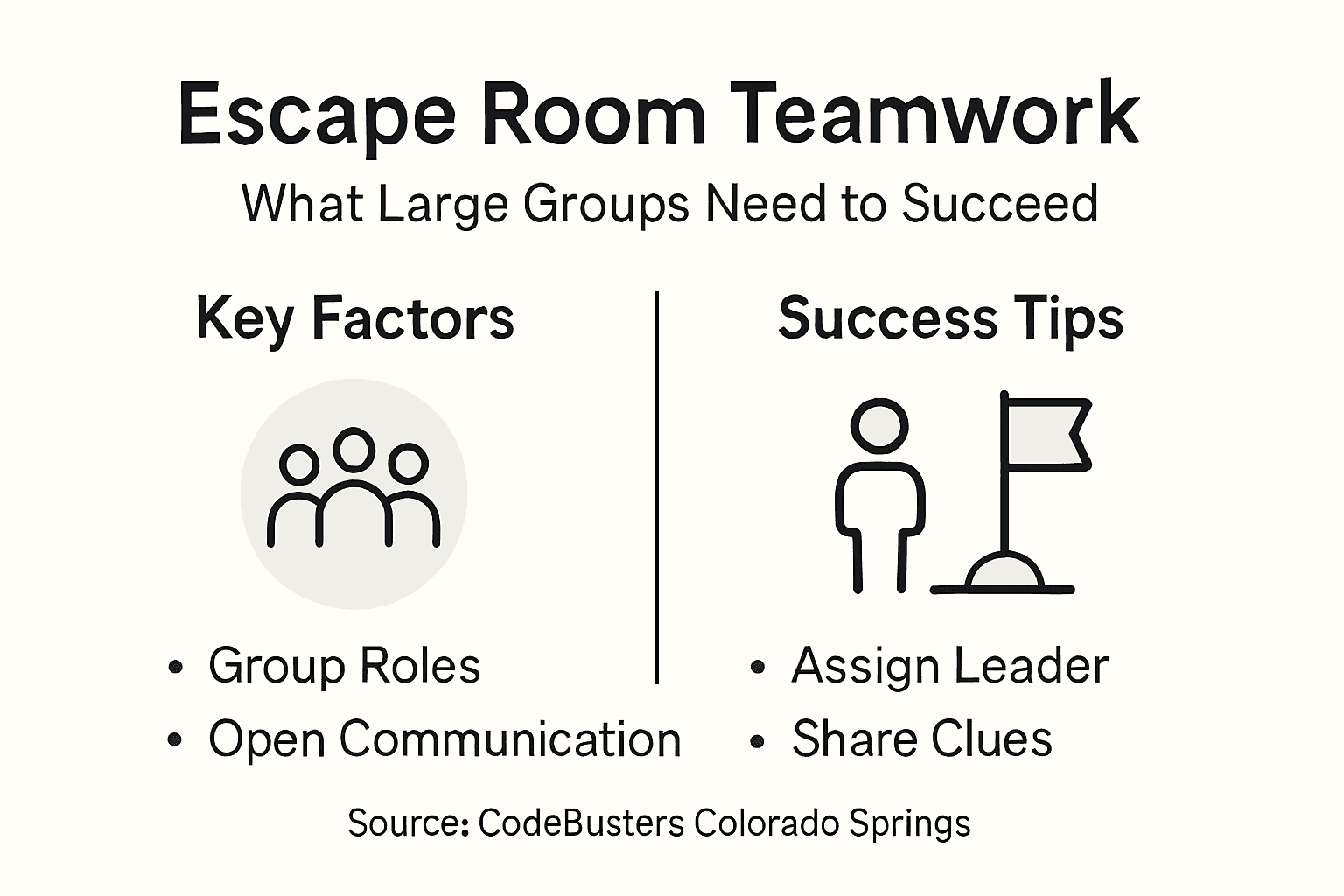
Pro tip: Assign a timekeeper and a note-taker before entering—these roles prevent information loss and keep your team synchronized during the scramble.
Popular Room Styles and Formats
Escape rooms come in multiple formats beyond the traditional physical room experience. Your team in Colorado Springs can choose from physical rooms, digital formats, and hybrid experiences depending on your goals, budget, and group dynamics. Each format offers distinct advantages for large group teamwork.
The following table compares escape room formats for large groups:
| Format Type | Group Suitability | In-Person Interaction | Best For |
|---|---|---|---|
| Physical | Groups up to 30 | Full face-to-face | Communication, leadership development |
| Hybrid | Distributed teams | Partial, with tech aids | Flexibility, tech skill integration |
| Digital | Large, remote groups | None, virtual only | Cost control, remote team-building |
Physical Rooms
Physical escape rooms remain the gold standard for team building. Your group enters a tangible space with real puzzles, props, and environmental clues that demand hands-on collaboration.
What makes them effective:
- Everyone shares the same sensory environment and time pressure
- Physical objects create natural division of labor
- Face-to-face interaction reveals actual communication patterns
- No technical barriers slow down problem-solving
CodeBusters Escape Room offers immersive themed experiences like “Past to the Future” and “Stranger 80’s” designed specifically for corporate teams seeking authentic collaboration experiences.
Digital and Hybrid Formats
Escape room diversity includes physical, hybrid, and digital modes designed for team-building and educational purposes. Hybrid rooms blend physical navigation with digital elements—think QR codes unlocking tablets with puzzles or AR clues layered over physical props.
Digital-only escape rooms work well when:
- Your team is distributed across multiple locations
- Budget constraints limit in-person options
- You need flexibility in scheduling or group size adjustments
- Virtual team-building is your primary goal
Physical rooms create accountability through shared space; digital rooms test communication when visual cues disappear.
Choosing the Right Format for Your Group
For Colorado Springs corporate teams, physical rooms deliver the strongest team-building impact. The inability to hide, the forced proximity, and the tangible puzzle elements reveal communication breakdowns immediately.
Consider your situation:
- First-time team building: Choose physical rooms for authentic interaction
- Distributed teams: Hybrid or digital formats work better
- Building specific skills: Physical rooms work best for communication and leadership development
- Large groups over 25 people: Multiple simultaneous physical rooms beat one huge digital experience
Your group size and current team dynamics should drive this choice, not just convenience.
Pro tip: Book a physical room format for maximum team transparency—the real value lies in watching how your team actually communicates when they can’t hide behind screens.
How Group Play Boosts Collaboration
Escape rooms create a structured environment where collaboration isn’t optional—it’s the only path to success. Your team experiences shared problem-solving that encourages collaborative cognition and collective decision-making in ways typical meetings never achieve. The pressure is real, the clock is ticking, and everyone’s contribution directly impacts the outcome.
Why Collaboration Happens Naturally
Unlike forced team-building exercises, escape rooms eliminate the awkwardness. Your team doesn’t gather to “build trust”—they gather to accomplish something concrete within 60 minutes. This shifts the dynamic entirely.
What changes in your group:
- Communication becomes explicit: Vague hints don’t work; you must clearly explain what you’re seeing and thinking
- Leadership emerges organically: Different people take charge for different puzzle types based on actual expertise
- Accountability surfaces: Everyone sees who contributes and who stalls
- Momentum builds collectively: Success on one puzzle energizes the group for the next challenge
This is fundamentally different from typical corporate meetings where participation feels optional.
Building Transactive Memory
Social learning through knowledge sharing strengthens transactive memory systems—the collective understanding of who knows what. In your team, transactive memory means people know not just facts, but also who to ask when they’re stuck.
During an escape room:
- Someone discovers a pattern in puzzles
- They communicate it verbally to the group
- Others build on that insight
- The team remembers that person as the problem-solver for similar challenges
High-performing teams don’t just solve problems better—they remember who solved what, and defer to that expertise next time.
This mental map of expertise accelerates decision-making long after the escape room ends.
Motivation Through Meaningful Challenges
The narrative-driven puzzles at CodeBusters Escape Room create intrinsic motivation that worksheets never achieve. Your team isn’t completing tasks for grades or compliance—they’re solving puzzles to progress through a story.
This matters because:
- Intrinsic motivation outlasts external rewards
- Story context makes challenges feel meaningful, not arbitrary
- Team members invest personally in the outcome
- Success feels earned, not manufactured
Your Colorado Springs team walks out energized, not exhausted from forced fun.
Pro tip: Debrief immediately after finishing—ask your team what surprised them about how they communicated, who emerged as leaders, and what they’d do differently next time. This reflection locks in the collaboration lessons.
Logistics, Booking, and Room Selection
Booking escape rooms for large groups requires strategic planning around capacity, timing, and room selection. Successful logistics involve scheduling advance bookings to ensure preparation, aligning room themes with team objectives, and considering reset times between sessions. For corporate teams in Colorado Springs, these details separate a successful team-building experience from logistical chaos.
Understanding Group Size and Capacity
Room capacity directly impacts team dynamics. Most escape rooms accommodate 4-10 people optimally per room, meaning your larger group needs multiple simultaneous bookings or sequential sessions.
How group size affects logistics:
- Under 10 people: Single room works well; everyone stays engaged
- 10-20 people: Two simultaneous rooms; creates friendly competition
- 20-30 people: Three or more rooms needed; requires coordinated scheduling
- Over 30 people: Consider splitting across multiple days or hybrid approaches
CodeBusters Escape Room can accommodate private bookings for your entire group across multiple themed experiences like “Past to the Future” and “Flight of Deception.”
Strategic Room Selection
Different rooms serve different team-building goals. Room selection must align with group size, scenario complexity, and your specific team objectives. A room that’s too easy wastes the experience; one that’s too difficult creates frustration instead of collaboration.
Choose based on:
- New team members: Select moderate difficulty to build confidence
- Experienced teams: Choose harder puzzles to challenge communication
- Mixed skill levels: Pick rooms with varied puzzle types so everyone contributes
- Specific goals: Use theme selection to support learning (cybersecurity, leadership, problem-solving)
Your room choice should challenge your team just enough to require real collaboration, not so much that they quit mentally.
Booking Strategy and Timing
Advance booking is non-negotiable for large groups. Schedule at least 2-3 weeks ahead to secure preferred times and allow room reset preparation between your team sessions.
Key logistics to arrange:
- Confirm exact headcount to guarantee room capacity
- Communicate arrival time (typically 15 minutes before start)
- Arrange concurrent room bookings if splitting your group
- Plan 10-15 minute breaks between sessions for team discussion
- Allow flexibility for rooms running slightly over time
Clarify with CodeBusters whether your booking includes pre-room briefing, photo opportunities, or group certificates—these details enhance the corporate experience.
Consider these key factors when planning your escape room booking:
| Booking Factor | Impact on Experience | Suggestion |
|---|---|---|
| Team Size | Affects engagement and logistics | Divide into 8-10 per room |
| Room Difficulty | Impacts motivation and collaboration | Match to collective skill level |
| Timing | Influences energy and focus | Choose weekday mornings |
| Debriefing | Locks in learning and improvement | Schedule immediately after session |
Pro tip: Book your rooms during morning or early afternoon slots on weekdays when possible—less crowded environments mean fresher puzzles, better game master attention, and fewer technical hiccups that derail team focus.
Key Planning Factors and Pitfalls to Avoid
Successful escape room experiences require deliberate planning beyond just booking a room and showing up. Puzzle design, group size alignment, and challenge balancing are critical to maintain motivation without discouragement. Many corporate teams experience disappointing outcomes not because the room was bad, but because planning overlooked these foundational factors.
Challenge Level Calibration
Your team’s experience depends on matching puzzle difficulty to their actual skill level, not perceived skill. Too easy and your group becomes bored; too hard and frustration kills collaboration.
Factors affecting difficulty perception:
- Prior escape room experience: First-timers need moderate difficulty; veterans want challenge
- Team composition: Mixed backgrounds need varied puzzle types so everyone solves something
- Time pressure tolerance: Some teams thrive under pressure; others freeze
- Puzzle type preferences: Some groups love logic; others prefer physical manipulation
Tell CodeBusters your team’s experience level when booking—they’ll recommend the appropriate themed room from their collection.
Common Planning Mistakes
Preparation, testing, and reflection stages maximize learning and team development outcomes. Skipping these stages creates wasted potential and frustrated participants.
Pitfalls to avoid:
- Incomplete briefing: Not explaining the rules clearly causes confusion and frustration
- Poor hint management: Giving hints too early robs your team of accomplishment; too late creates despair
- Overcrowding rooms: Stuffing 12 people into a 6-person room kills collaboration
- No post-experience debrief: Missing reflection means your team forgets the lessons immediately
- Wrong room difficulty: Mismatching challenge level to your team sabotages the entire experience
Failure during escape rooms teaches valuable lessons only if your team feels safe trying, failing, and trying differently.
Managing Anxiety and Psychological Safety
Failure triggers anxiety in competitive corporate environments. Your team needs psychological safety—the assurance that mistakes don’t threaten their standing or reputation.
How to build this:
- Frame the experience as learning, not evaluation
- Celebrate failed attempts that reveal communication issues
- Remind your team that every room is designed to be hard
- Share that most teams don’t escape on first attempts
- Ask your game master to emphasize collaboration over individual performance
When your team feels safe to fail, they actually solve more puzzles because they take real risks instead of playing it safe.
Pro tip: Brief your team 30 minutes before the room about what you’re observing—communication patterns, leadership emergence, decision-making speed. This primes them to be self-aware during the experience, amplifying the learning impact dramatically.
Boost Your Teamwork with CodeBusters Escape Room Experiences
Unlock your team’s true potential by addressing communication gaps and leadership dynamics revealed in large group escape rooms. The challenges of coordinating 12 to 30 people can expose hidden collaboration hurdles but also create incredible growth opportunities. At CodeBusters Escape Room, we specialize in immersive themed adventures like Past to the Future and Flight of Deception designed to engage every member and sharpen collective problem-solving skills under real-time pressure.
Ready to transform your corporate team in Colorado Springs with hands-on, face-to-face collaboration that reveals exactly how your group communicates and leads? Don’t wait until hidden issues slow you down in the workplace. Visit CodeBusters Escape Room now and book your private large group session. Experience how our award-winning rooms help you build trust, motivate meaningful teamwork, and unlock new levels of team success today.
Frequently Asked Questions
What are the benefits of participating in an escape room for large groups?
Escape rooms enhance teamwork by improving communication, decision-making, and accountability. They create a shared experience that encourages collaboration under time pressure, revealing how teams function in high-stress situations.
How many people can participate in a large group escape room?
Most escape rooms accommodate 4-10 people per room effectively. For larger groups, it’s recommended to book multiple rooms to ensure everyone can engage and participate actively.
How do I choose the right escape room format for my group?
Select a format based on your team’s dynamics and objectives. Physical rooms are ideal for hands-on collaboration, while digital and hybrid formats offer flexibility for distributed teams or budget constraints.
What factors should I consider when planning an escape room experience for my team?
Key factors include group size, room difficulty, and scheduling. Ensure the room’s challenge level matches your team’s skills to maximize motivation and team-building effectiveness.
Recommended
- CodeBusters Escape Room | Escape Rooms | Colorado Springs
- How Hanselmann Uses Layout to Create Claustrophobia – The Mansion Press