Master Team Building Escape Room Workflow for Success

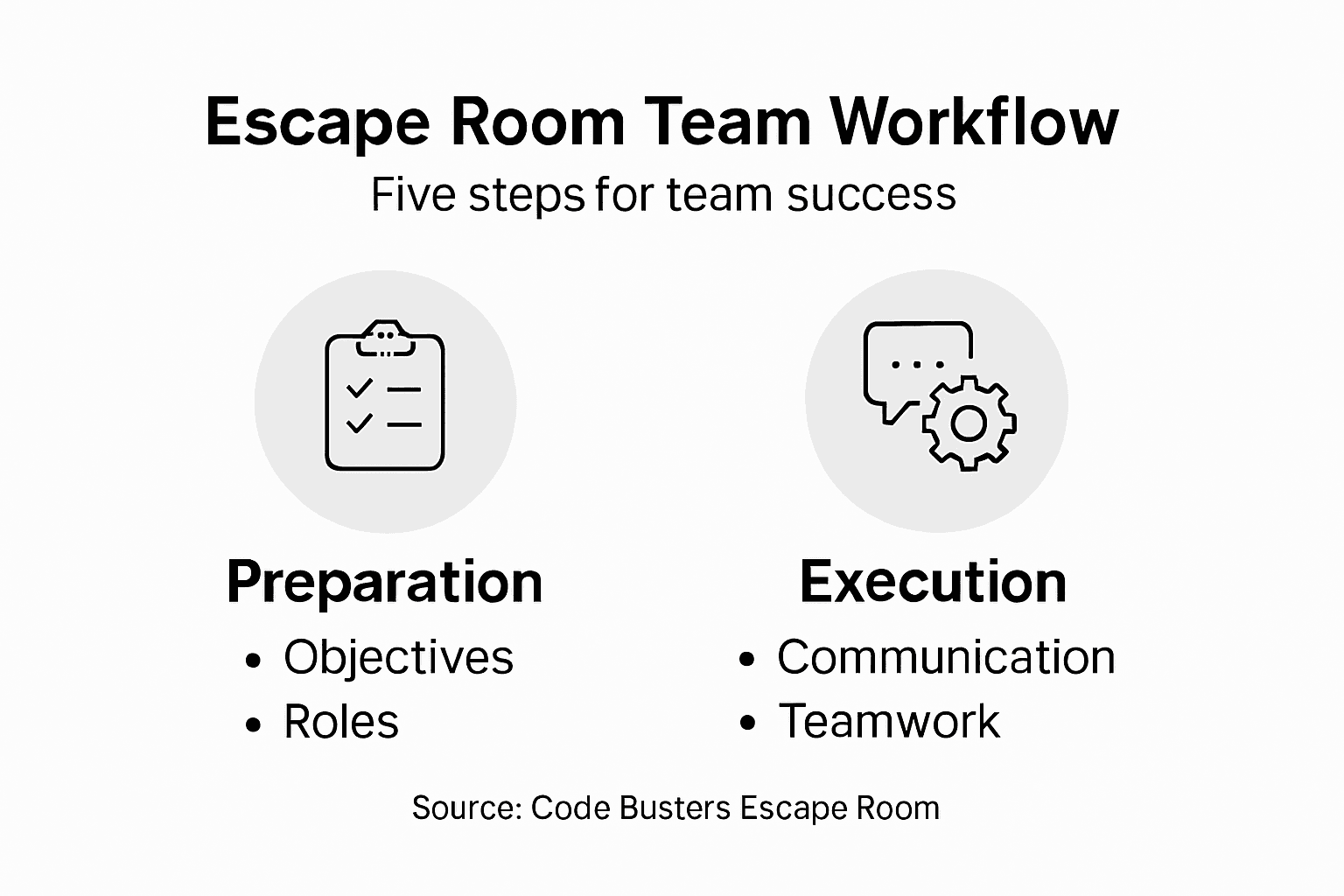
Every team leader knows the challenge of motivating staff to work together under pressure. In Colorado Springs, escape rooms provide an exciting way to strengthen collaboration and communication by offering carefully designed puzzle-based scenarios. Selecting the right experience lets you focus on your specific goals and build a more unified team. Thoughtfully designed escape room activities can assess and develop critical skills that drive real progress.
Table of Contents
- Step 1: Define Objectives And Select An Escape Room Experience
- Step 2: Assemble Teams And Assign Specific Roles
- Step 3: Review Challenge Rules And Establish Communication
- Step 4: Lead The Escape Room Session For Effective Teamwork
- Step 5: Debrief Teams And Evaluate Outcomes Collaboratively
Quick Summary
| Key Insight | Explanation |
|---|---|
| 1. Define team objectives first | Clearly outline goals for team development before selecting an escape room experience. |
| 2. Assemble diverse teams strategically | Ensure team composition balances skills, cognitive styles, and communication compatibility. |
| 3. Establish effective communication | Implement clear communication protocols to enhance teamwork and problem-solving during the session. |
| 4. Lead with supportive observation | Monitor team dynamics and provide hints thoughtfully to help maintain motivation and focus. |
| 5. Conduct a meaningful debrief | Facilitate a collaborative reflection session post-activity to assess performance and identify improvements. |
Step 1: Define objectives and select an escape room experience
Mastering team building through escape rooms starts with strategically defining clear objectives that align with your organizational goals. By carefully selecting the right escape room experience, you can transform a simple activity into a powerful team development opportunity. Your primary focus should be on identifying specific skills and dynamics you want your team to enhance.
To select the ideal escape room, consider these critical components:
- Team communication improvement goals
- Current team collaboration challenges
- Desired problem-solving skill development
- Participant skill levels and experience
Research demonstrates that thoughtfully designed escape room experiences can systematically assess and build critical teamwork capabilities. Your selection process should involve understanding each room’s unique puzzle structure, thematic complexity, and potential skill-building opportunities.
Successful team building requires matching the escape room’s difficulty and design to your specific developmental objectives.
Consider evaluating potential escape rooms based on these key assessment criteria:
- Puzzle complexity matching team skill level
- Narrative engagement and immersion potential
- Required collaborative problem-solving elements
- Time constraints and difficulty settings
Pro tip: Schedule a preliminary team discussion to align expectations and generate excitement about the upcoming escape room challenge.
Step 2: Assemble teams and assign specific roles
Building a successful escape room team requires strategic planning and thoughtful role allocation to maximize collaborative potential. Your goal is to create a balanced group that can effectively tackle complex challenges while ensuring every member contributes meaningfully to the overall mission.
Effective team composition strategies demand careful consideration of individual strengths and complementary skills. To optimize your team’s performance, focus on these key elements:
- Diversity of skill sets
- Balanced cognitive abilities
- Complementary personality types
- Communication compatibility
Consider the following approach to role assignment:
- Identify individual team member strengths
- Match skills to specific puzzle-solving requirements
- Rotate roles to maintain engagement
- Ensure balanced participation
Strategic role allocation transforms a group of individuals into a cohesive problem-solving unit.
When assigning roles, pay attention to key positions that will drive team success:
Here is a summary of typical escape room team roles and their organizational benefits:
| Role | Core Responsibility | Business Benefit |
|---|---|---|
| Puzzle Decoder | Solve clues efficiently | Encourages analytical thinking |
| Time Keeper | Monitor deadlines | Builds prioritization skills |
| Communication Coordinator | Facilitate message flow | Enhances internal coordination |
| Resource Manager | Organize found items | Improves resource management |
- Puzzle Decoder: Detail-oriented team member
- Time Keeper: Manages group pace and urgency
- Communication Coordinator: Facilitates information sharing
- Resource Manager: Tracks and organizes discovered clues
Pro tip: Conduct a brief pre-game team meeting to discuss individual strengths and establish initial role expectations.

Step 3: Review challenge rules and establish communication
Successful escape room experiences hinge on clear communication and a comprehensive understanding of challenge rules. Your team must develop a shared strategy that ensures everyone knows exactly how to approach the puzzles, time constraints, and collaborative requirements.
Challenge rule establishment strategies emphasize the importance of creating a transparent communication framework before diving into the experience. To set your team up for success, focus on these critical communication principles:
- Active listening techniques
- Clear information sharing protocols
- Respectful dialogue guidelines
- Efficient problem-solving communication
Consider implementing these communication guidelines:
- Establish a central communication hub
- Define clear verbal and non-verbal signaling methods
- Create a system for sharing discovered clues
- Agree on decision-making processes
Effective communication transforms individual efforts into a cohesive team strategy.
Key communication strategies to implement:
- Verbal Updates: Regularly share observations
- Physical Signaling: Use hand gestures for quick communication
- Role-Based Reporting: Each team member shares specific insights
- Conflict Resolution: Quickly address and resolve disagreements
Pro tip: Designate a team communication leader who can help facilitate smooth information exchange and keep the group focused during high-pressure moments.
Step 4: Lead the escape room session for effective teamwork
Leading an escape room session requires a delicate balance of guidance, support, and strategic intervention to maximize team potential. Your role is to create an environment that fosters collaboration, problem-solving, and collective achievement without undermining the group’s autonomy.
Team leadership strategies emphasize the importance of providing nuanced support during challenging moments. To effectively guide your team, consider these critical leadership approaches:
- Observe team dynamics without direct interference
- Provide strategic hint management
- Maintain positive momentum
- Encourage collaborative problem-solving
Implement these leadership techniques during the escape room experience:
- Monitor team communication
- Identify potential bottlenecks
- Offer targeted hints when progress stalls
- Validate team efforts and achievements
Effective leadership transforms a group of individuals into a unified problem-solving unit.
Key leadership strategies to implement:
Compare the impact of key leadership actions in escape room team building:
| Leadership Action | Team Experience Effect | Long-Term Skill Outcome |
|---|---|---|
| Neutral Observation | Encourages self-direction | Fosters group independence |
| Timely Interventions | Prevents frustration | Teaches supportive leadership |
| Emotional Support | Boosts morale during stress | Builds team trust and resilience |
| Performance Reflection | Promotes continuous learning | Strengthens feedback culture |
- Neutral Observation: Watch team interactions
- Timely Interventions: Provide hints without solving puzzles
- Emotional Support: Maintain team morale
- Performance Reflection: Discuss team dynamics post-experience
Pro tip: Create a subtle, supportive presence that guides without dominating, allowing the team to discover solutions independently.
Step 5: Debrief teams and evaluate outcomes collaboratively
The debrief phase represents a critical opportunity to transform an escape room experience into a meaningful learning journey. Your goal is to facilitate a structured conversation that helps team members reflect on their performance, identify strengths, and discover areas for future improvement.
Post-escape room reflection strategies emphasize the importance of collaborative evaluation. To conduct an effective debrief, focus on creating an open, constructive environment where all team members can share insights:
- Encourage honest feedback
- Maintain a non-judgmental atmosphere
- Highlight collective achievements
- Discuss individual and team learning
Follow these structured debriefing steps:
- Start with team’s overall perception
- Review specific puzzle-solving approaches
- Analyze communication dynamics
- Explore potential improvement strategies
A well-conducted debrief transforms an escape room from an activity into a powerful team development experience.
Key debrief discussion elements:
- Performance Analysis: Objective review of team performance
- Communication Review: Examine interaction patterns
- Problem-Solving Evaluation: Assess collaborative strategies
- Future Improvement Planning: Develop actionable insights
Pro tip: Create a safe space for vulnerability by sharing your own observations first, modeling constructive and supportive feedback.
Elevate Your Team Building with Expertly Designed Escape Rooms
Mastering the team building escape room workflow means overcoming challenges like communication barriers and role confusion. The article highlights the importance of clear objectives, strategic role assignment, effective communication, strong leadership, and collaborative debriefing to unlock your team’s full potential. If your team struggles with these or you want to ignite problem-solving and trust through immersive experiences, you need a partner who excels in delivering tailored challenges that suit your goals.
At Code Busters Escape Room, we specialize in creating unforgettable, high-quality escape room experiences in Colorado Springs designed specifically for corporate teams and groups seeking dynamic team building. Our unique themed rooms such as “Past to the Future” and “Flight of Deception” offer puzzles and narratives crafted to enhance collaboration, critical thinking, and communication—the exact competencies the article advises focusing on. With private room bookings and customizable difficulty levels, your team can practice role allocation, strategic communication, and leadership in an exhilarating environment.
Why settle for ordinary team activities when you can transform your group into a cohesive problem-solving force right now? Visit Code Busters Escape Room today to explore our award-winning escape room options and book a session that will challenge and unite your team. Take action now to turn your team building goals into rewarding achievements with hands-on experiences that foster real growth.
Frequently Asked Questions
How do I define objectives for a team building escape room experience?
Begin by identifying the key skills and dynamics your team needs to enhance, such as communication or collaboration. Set clear goals to match the escape room challenges with these objectives, ensuring the experience is aligned with your organizational needs.
What factors should I consider when selecting an escape room?
Evaluate the escape room’s puzzle complexity, theme, collaborative requirements, and participant skill levels. Choose a room that both engages your team and challenges their problem-solving abilities effectively.
How can I assign roles effectively within my escape room team?
Identify each team member’s strengths and align them with the specific requirements of the puzzles. Assign roles such as Puzzle Decoder or Time Keeper to ensure balanced participation and harness individual skills for optimal team performance.
What communication strategies should my team use during the escape room session?
Establish a central communication hub and define clear methods for verbal and non-verbal communication. This ensures that all team members are aligned, allowing for efficient sharing of observations and discoveries throughout the challenge.
How do I conduct a productive debrief after the escape room experience?
Start the debrief by encouraging team members to share their overall perceptions and insights honestly. Review specific communication dynamics and problem-solving approaches to identify strengths and areas for improvement for future team-building activities.
What should I focus on as a leader during the escape room session?
Observe team dynamics and facilitate problem-solving without interfering directly. Provide timely hints and emotional support to keep the team motivated, ensuring that everyone feels valued and engaged throughout the experience.
Recommended
Article generated by BabyLoveGrowth