Cancel or Reschedule in 5 Minutes: Escape Room Cancellation Policy

Most escape rooms require at least a full day of notice to cancel or reschedule for free; wait longer than that and you’ll likely lose your deposit or full payment. Pull up your booking confirmation now, since it lists your exact window and the operator’s contact info. Emergencies and operator-side cancellations (weather, equipment failure) are usually the only exceptions to strict enforcement.
Table of Contents
- What Does an Escape Room Cancellation Policy Actually Say?
- How to Cancel or Reschedule Your Escape Room Booking
- No-Shows, Late Arrivals, Group Changes, and Vouchers
- When Can You Actually Get a Refund?
- How to Avoid Losing Your Booking in the First Place
- How CodeBusters Escape Room Handles Bookings and Cancellations
- Handling Cancellations Due to COVID-19 or Other Emergencies
- Cancellation Rules for Corporate and Large Group Bookings
- What Fees or Penalties Apply for Late Cancellations?
- Why Clear Cancellation Rules Protect Both Sides
- Ready to Rebook? Here’s What to Do Next
- Sources
- FAQ
What Does an Escape Room Cancellation Policy Actually Say?
Every escape room cancellation policy runs on one core idea: the notice period. That’s the amount of time before your scheduled game when you can still back out and get something back. Miss it, and you’re at the operator’s mercy.
The math is simple once you see it laid out. A cancellation notice given the day before your slot usually qualifies for a refund; canceling later often does not. Some venues require longer notice periods for larger private rooms, as they’ve likely turned away other bookings to hold your slot.
Here’s the vocabulary that actually matters when you’re reading the fine print:
- Full refund — money back to your original payment method, usually only inside the notice window.
- Credit — the amount applied toward a future booking, often issued for late cancellations instead of cash back.
- Reschedule — moving your existing booking to a new date without forfeiting anything, sometimes allowed once as a courtesy.
- Forfeiture — you lose the payment entirely, common for no-shows or same-day cancellations.
Common triggers that flip a booking from “refundable” to “forfeited” include no-shows, arriving late beyond the operator’s allowed grace period, and dropping below an operator’s minimum player count. Operator FAQs and customer reviews consistently mention notice periods around one to two days paired with strict no-refund clauses for late or missed bookings.
How to Cancel or Reschedule Your Escape Room Booking
Handling a cancellation or reschedule takes five minutes if you move fast and keep records. Here’s the sequence that works almost every time:
- Find your confirmation email or text. It has your booking reference, the notice window, and often a direct cancellation link.
- Check the clock against the window. Know exactly how many hours you have before the deadline flips your refund odds.
- Use the self-service portal if one exists. Many booking systems let you cancel or reschedule with a few clicks, no phone call needed.
- Call or email if there’s no portal. Reference your booking number directly so the venue doesn’t have to hunt for your reservation.
- Get written confirmation of whatever you agreed to. A screenshot or forwarded email showing “cancelled” or “rescheduled” status protects you if a refund doesn’t show up as promised.
Pro Tip: Screenshot the cancellation confirmation the moment you get it. If a refund takes longer than promised, that timestamp is your proof you acted inside the window.
Refunds to a card typically take a few business days to post, even after the venue processes them instantly on their end. If nothing shows up after a week, that confirmation screenshot is what you’ll need to follow up.
No-Shows, Late Arrivals, Group Changes, and Vouchers
No-shows almost never get refunded, and there’s a business reason behind it: the room was held exclusively for your group, staff prepped the puzzles, and no other customer could book that slot. Late arrivals face the same logic on a smaller scale, since most venues cap your window at 10 to 15 minutes before giving your slot away.
A few other edge cases trip people up regularly:
- Minimum player counts exist because pricing is often built around a room filling to capacity. Drop below the minimum, and you may owe a per-person shortfall fee rather than losing the whole booking.
- Gift vouchers that go unused for a cancelled game typically convert to store credit rather than cash, and that credit usually carries its own expiration date separate from the original voucher.
- Shrinking group sizes rarely kill a booking outright. Most operators will rebook you at a smaller room size, charge a per-head adjustment fee, or offer a partial credit for the difference.
The pattern across nearly all these situations: cash refunds are rare, but credit, rescheduling, or fee adjustments are usually on the table if you communicate before game time rather than after.
When Can You Actually Get a Refund?
Refunds outside the standard window aren’t impossible, just rare, and they hinge on documentation. Operators generally make exceptions for serious illness, a family emergency, or a venue-side problem like a closure or equipment failure.
What actually moves the needle when you ask for an exception:
- Written proof — a doctor’s note, a screenshot of a cancelled flight, or an email showing the venue closed unexpectedly.
- Prompt contact — reaching out the moment you know you can’t make it, not days later.
- A clear, factual request — state what happened, when, and what you’re asking for (refund, credit, or reschedule).
Disputes tend to succeed when the customer documents the emergency in writing and contacts the venue quickly, rather than waiting and hoping the operator remembers the circumstances favorably. A credit-card chargeback is a real option, but treat it as the last resort after the venue has refused a reasonable, documented request. Disputing prematurely can burn a relationship you might want for a future rebooking.
How to Avoid Losing Your Booking in the First Place
The best defense against a denied refund is reading the fine print before you need it. Save your confirmation email somewhere you’ll actually find it again, not buried in a promotions folder.
A few habits pay off every time:
- Screenshot or print the cancellation terms the day you book, since some sites update FAQ pages later.
- Pick a refundable rate when one is offered, even if it costs a little more upfront.
- Confirm your exact headcount a day or two ahead rather than the morning of your slot.
- Arrive 10 to 15 minutes early. That buffer alone prevents most “late arrival” forfeitures.
Pro Tip: Save the operator’s phone number in your contacts the day you book, not the day you need to cancel. A five second call beats a missed email when you’re racing a deadline.
How CodeBusters Escape Room Handles Bookings and Cancellations
The operator emphasizes clear communication in how bookings are handled, not just in marketing. Booking confirmations typically spell out expectations on both sides before you arrive.
Policy details, age requirements, and booking logistics are documented across the site’s blog posts on escape room age limits and related booking guides, so you’re not guessing at fine print buried in a footer. A transparent provider states the rules once, in writing, and holds to them for consistency.
Handling Cancellations Due to COVID-19 or Other Emergencies
Emergencies fall into a different category than a simple change of plans, and most escape room operators treat them that way. A confirmed COVID-19 diagnosis, a sudden illness, a death in the family, or a government-mandated closure typically qualifies for flexibility that a standard “I forgot” cancellation wouldn’t get.
The practical difference is documentation and timing. Operators generally want to hear from you as soon as you know you can’t make it, not after the scheduled time has passed. A positive test result, a doctor’s note, or even a clear written explanation of what happened strengthens your case considerably. Venues that once ran automatic no-refund policies during 2020 and 2021 often built in illness related exceptions permanently afterward, since so many bookings were affected by circumstances entirely outside the customer’s control.
That said, don’t assume “emergency” language in a policy means automatic cash back. Most operators will offer a reschedule or credit first, reserving actual refunds for cases where rebooking isn’t realistic, such as a visitor whose trip got cancelled entirely. If a venue-side emergency causes the cancellation instead, like a power outage or a maintenance issue that closes the room, you’re on much stronger ground for a full refund since the operator, not you, broke the agreement.
The safest move either way is the same one that applies to every exception request: contact the venue immediately, explain what happened in plain terms, and ask directly what your options are rather than assuming the worst.
Cancellation Rules for Corporate and Large Group Bookings
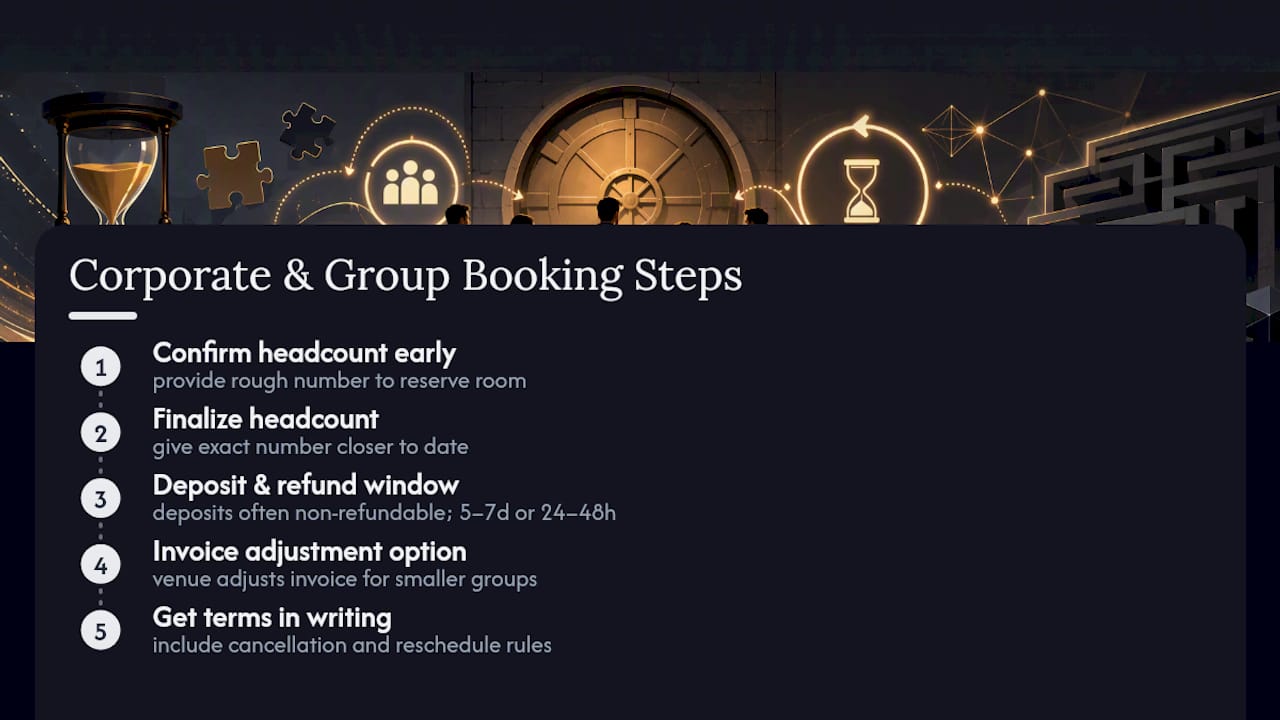
Corporate and large group bookings run on stricter terms than a typical booking for two to six people, and there’s a straightforward reason: the venue has often blocked out an entire private room, dedicated staff, and sometimes multiple time slots to accommodate a bigger party.
Deposits are common for these bookings, and they’re frequently non-refundable past a certain point, sometimes a week or more before the event. That’s because a corporate team-building booking or a birthday party for fifteen people represents lost revenue the venue can’t easily recover by filling the slot with walk-ins on short notice. Expect the notice window for a full refund to be longer than the standard 24 to 48 hours, sometimes stretching to five or seven days for the largest bookings.
Group size changes get handled with more flexibility than outright cancellations. If your group of twenty drops to fourteen, most operators would rather adjust your invoice and rebook you at the smaller headcount than lose the booking entirely. The group booking process for events in Colorado Springs generally works this way: organizers confirm a rough headcount early, then finalize the exact number closer to the date, which gives the venue time to plan staffing and puzzle setups without scrambling.
If you’re the one organizing a company outing or a big family event, ask about the deposit terms and the exact refund window before you pay anything, not after. Corporate event planners in particular should get the cancellation and rescheduling terms in writing, since a verbal assurance from a booking call won’t help you if a dispute comes up later. For private room bookings especially, the deposit structure often differs meaningfully from a standard public-slot reservation.
What Fees or Penalties Apply for Late Cancellations?
Cancel outside the standard window, and you’re typically looking at one of three outcomes: forfeiting your full payment, losing your deposit specifically, or paying a reduced penalty fee that’s less than the full booking cost.
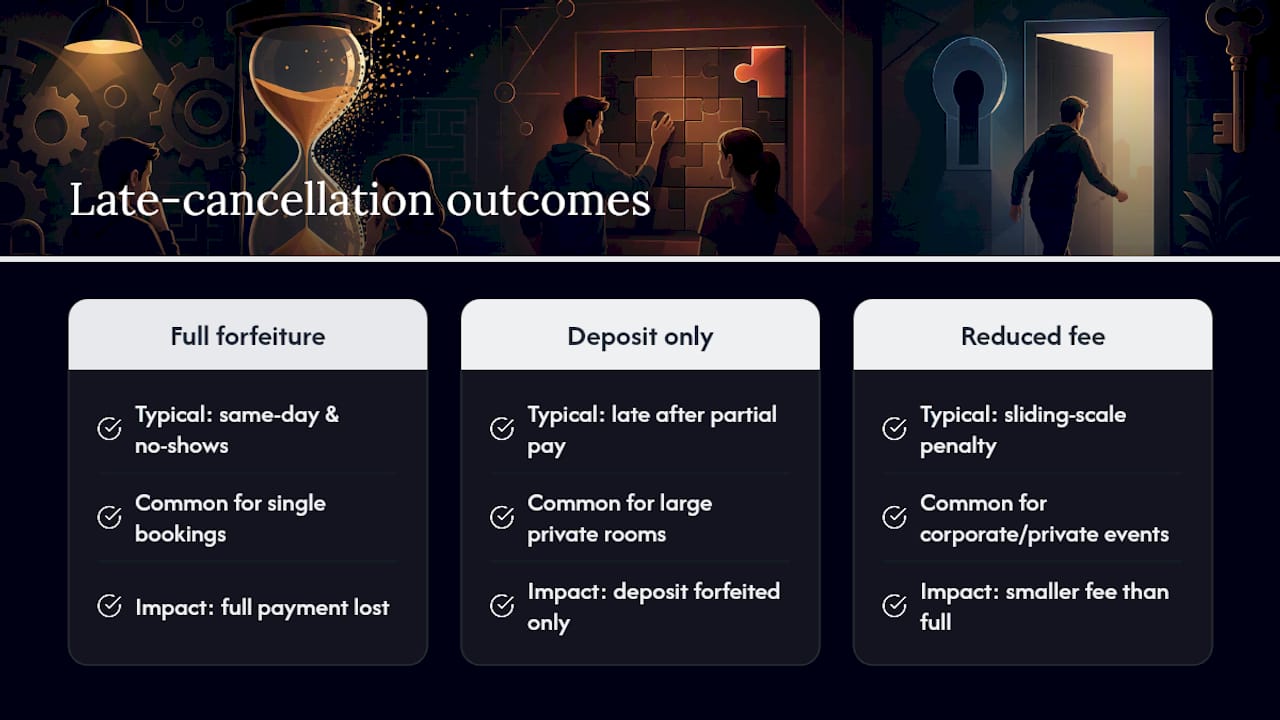
Full forfeiture is most common for same-day cancellations and no-shows, since the venue had zero time to fill that slot with another group. A deposit-only forfeiture is more common when you’ve paid partially upfront for a larger private room booking. In that case, canceling late costs you the deposit, but any additional balance due at check-in simply doesn’t get charged.
Some operators use a sliding scale instead of an all-or-nothing rule. This tiered approach is more common with corporate bookings and large private events than with a standard two-person reservation, since the financial stakes for the venue scale up with group size.
The one thing that rarely changes across venues: rescheduling is treated far more leniently than canceling outright. A venue that would deny a refund for a same-day cancellation will often still let you move to a new date, sometimes even without a fee, because rescheduling means the venue keeps the revenue and just delays when it books. That distinction alone is worth remembering the next time your plans fall through. If you know a date won’t work anymore, ask for a reschedule before you ask for a refund. It’s the path of least resistance almost everywhere.
Why Clear Cancellation Rules Protect Both Sides
Notice windows aren’t arbitrary. A private room booked for your group means staff prepped puzzles, blocked the slot from other customers, and often turned away walk-ins who wanted that exact time. When you cancel with real notice, the venue can actually fill that gap. When you don’t, that revenue and labor are just gone.
Courteous early notice isn’t a favor to the venue, it’s what keeps flexible policies possible at all. Every operator balances flexibility against price, and the venues offering generous reschedule terms are usually the ones whose customers respect the windows in the first place.
— CodeBusters
Ready to Rebook? Here’s What to Do Next
If your plans change and you need to shift your booking, some operators strive to make that process as painless as possible, inspired by The Backrooms themed escape rooms and their hidden details. Some venues publish their booking and contact details directly on the site to avoid customers guessing who to call.

Before you reach out, have your booking reference and a couple of preferred alternate dates ready. That’s really all it takes to get a fast answer instead of a back-and-forth email chain. Head to the Codebusters Escape Room booking page to check current availability or get in touch about changing an existing reservation. And whatever you do, keep that original confirmation email handy. It’s your quickest reference for exactly what your specific booking allows.
FAQ
Can You Get a Refund for an Escape Room Booking?
Yes, if you cancel inside the operator’s notice window, typically 24 to 48 hours before your slot. Cancel later than that and you’ll usually get a credit or reschedule offer instead of cash back.
Can You Leave an Escape Room Early Once It Starts?
Yes, you can ask to leave at any point, and staff will let you out immediately for safety reasons. Leaving early doesn’t typically entitle you to any refund, since the room and time slot were still reserved for your group.
Can You Quit or Cancel Mid-Game?
You can stop playing whenever you want, but quitting mid-game is treated the same as finishing the game for billing purposes. No standard escape room cancellation policy offers a partial refund for leaving early once the game has started.
What Happens if I Don’t Show Up for My Booking?
Most operators classify a no-show as a full forfeiture of payment, since the room, staff, and time slot were held exclusively for your group. Contacting the venue as soon as you realize you’ll miss it, even after the fact, occasionally opens the door to a credit rather than a total loss.
How Far in Advance Should I Cancel to Get a Full Refund?
Check your specific booking confirmation, but at least one full day before your scheduled time is a common window across operators. Larger group and corporate bookings often require longer notice due to the bigger financial commitment involved.