Why Diverse Teams Succeed: A Team-Building Guide
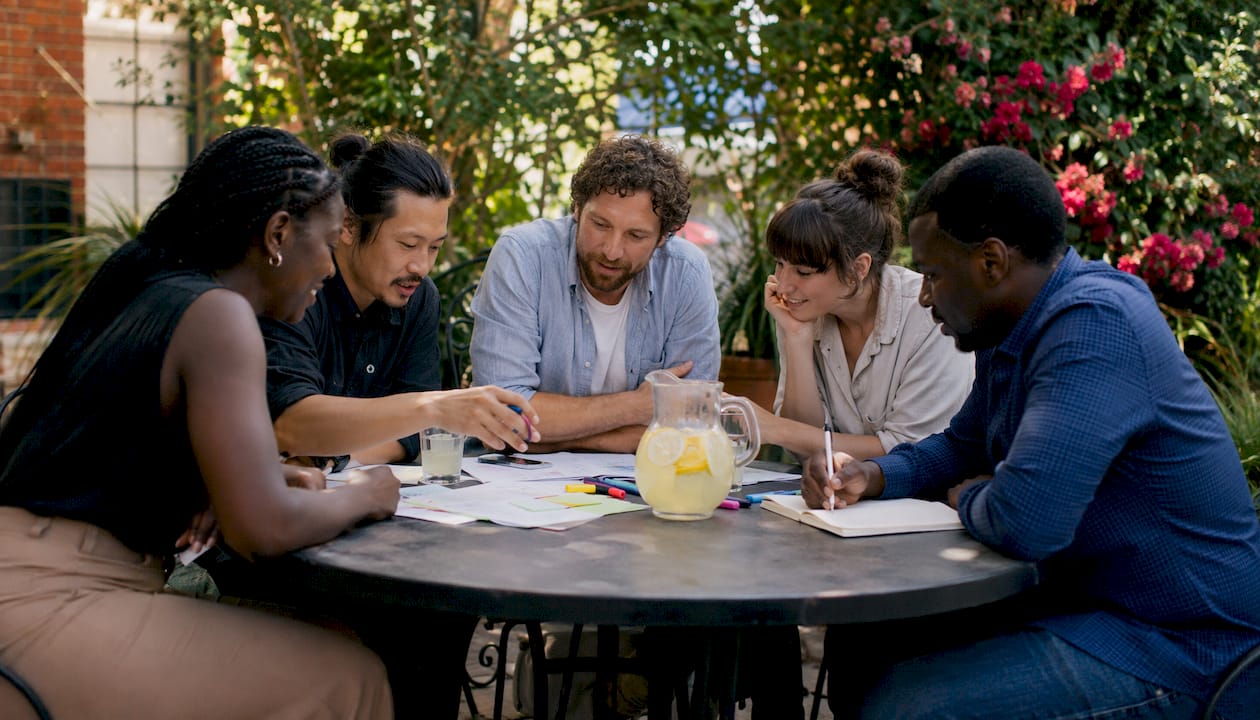
Diverse teams succeed because social differences make group members anticipate disagreement, prepare more thoroughly, and surface information they would otherwise keep to themselves — a cognitive “jolt” that Katherine Phillips documented across multiple studies. McKinsey found companies in the top quartile for board-gender diversity are 27% more likely to outperform financially. The catch: that jolt only converts to results when your team has structure, clear roles, and a facilitated space to share what they know — exactly what a private escape-room session at Codebusters Escape Room is designed to create.
- Diversity’s core benefit is cognitive: it forces harder thinking, not just broader representation.
- The mechanism is information elaboration — getting different knowledge out and used, not just present.
- Structure and facilitation are what separate a high-performing diverse team from a frustrated one.
Pro Tip: Before your session, assign each participant a specific information role (logistics, creative, analyst) so every perspective gets airtime from minute one.
Table of Contents
- Why diverse teams succeed: the research explained
- When does diversity backfire?
- How escape rooms create the conditions for diversity to work
- How to design a team-building session that captures the diversity advantage
- Why Codebusters Escape Room is built for this
- Key Takeaways
- What running these sessions has taught us
- Useful sources
Why diverse teams succeed: the research explained
The simplest way to understand the advantage is this: when people expect disagreement, they prepare more carefully. Phillips showed that even the anticipation of a different viewpoint pushes individuals to think harder before a group discussion begins. That preparation effect is real and measurable, and it does not require the diverse member to say anything especially brilliant.
The categorization–elaboration model adds a layer of nuance. Demographic diversity triggers two competing processes simultaneously. Social categorization — the brain sorting people into in-groups and out-groups — tends to reduce trust and communication. Information elaboration — the active sharing and processing of unique knowledge — is where the performance gains live. A meta-analysis of 38,304 teams confirmed that diversity reliably increases social categorization, but whether it also increases information elaboration depends heavily on context and task design.
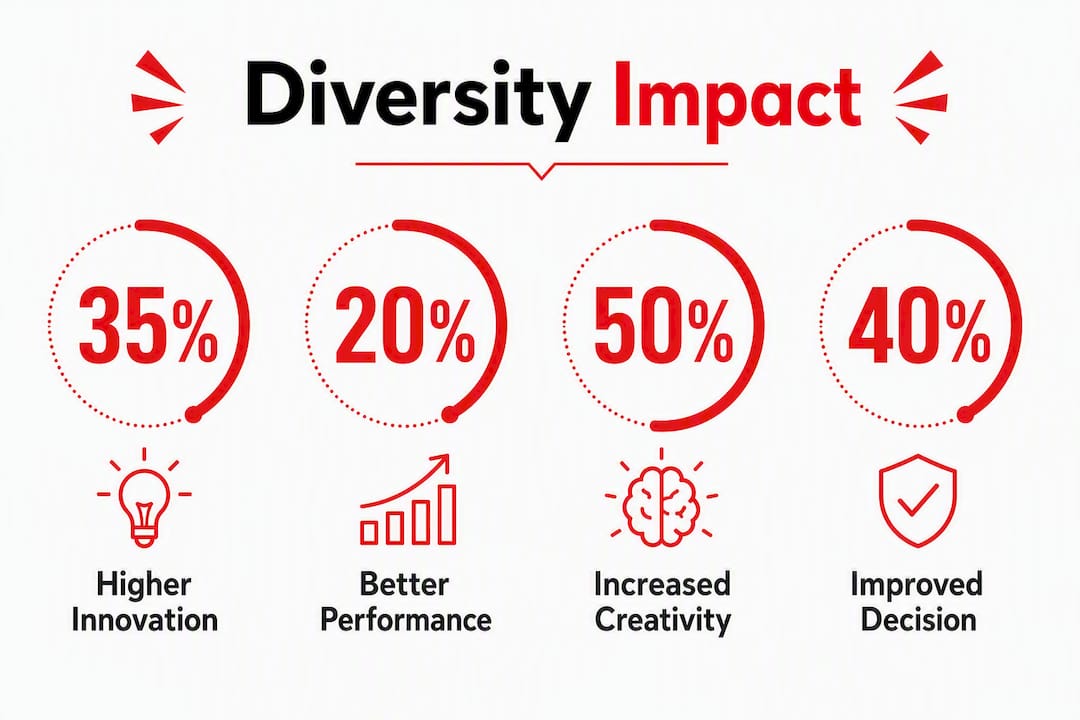
Which diversity dimensions actually move the needle? A global ILO study points to nationality diversity and specialization diversity as the most consistent drivers of team performance gains. First-language diversity and very large team size, by contrast, tend to create friction unless actively managed.
| Diversity dimension | Typical effect on performance | Key condition |
|---|---|---|
| Nationality | Positive | Structured communication |
| Specialization | Positive | Balanced subgroup composition |
| First language | Mixed/negative | Requires facilitator support |
| Team size (large) | Negative | Needs role clarity |
McKinsey’s data puts a business-case number on it: firms with higher board-gender diversity are more likely to outperform financially, and those with higher ethnic diversity show a similar trend. Those figures come from leadership teams, but the underlying mechanism — more perspectives, better decisions — scales down to a six-person escape room just as well.
When does diversity backfire?
Diversity without structure is not neutral. It can actively hurt performance, and the failure modes are predictable enough that you can spot them before a session goes sideways.
The main drivers of failure:
- Unmanaged social categorization: Cliques form along visible lines (department, nationality, seniority). Once subgroups stop talking to each other, information elaboration collapses.
- Language barriers: When one or two participants struggle to follow rapid conversation, they disengage. Their knowledge stays locked out of the group’s problem-solving.
- Overly large groups: Beyond a certain size, coordination costs outweigh the diversity dividend. The ILO study flags team size as a direct inhibitor of efficiency.
- Poorly defined roles: Without role clarity, dominant voices fill the vacuum. Quieter members with critical information never get a turn.
- Missing facilitation: Research on social friction is clear that diversity-driven discomfort is manageable — but only when someone is actively managing it.
In an escape room, these failures look concrete: one person takes over the puzzle board while three others watch; a non-native English speaker stops contributing after a miscommunication; two colleagues from the same department solve puzzles together and ignore the rest of the group. None of these are character flaws. They are predictable group dynamics.
Pro Tip: Watch the first three minutes. If the same one or two people are touching every puzzle, intervene early with a quick role reassignment — “You own the cipher, you own the map” — before the pattern locks in.
How escape rooms create the conditions for diversity to work
A well-designed escape room is almost accidentally a perfect environment for information elaboration. Time pressure forces the group to pool knowledge fast. Physical puzzle diversity — ciphers, spatial challenges, narrative clues, mechanical locks — draws on genuinely different cognitive strengths. Interdependence is built into the structure: no single person can solve everything alone.

Those features map directly onto the research. The categorization–elaboration meta-analysis found that high-interdependence tasks raise the opportunity for information elaboration, which is the mechanism that converts diversity into better outcomes. Escape rooms are high-interdependence by design. That is not a coincidence — it is why escape rooms build stronger teams in ways that a conference-room icebreaker rarely does.
Narrative roles help too. When a room assigns a character or a specific task to each player, it creates the role clarity that prevents dominant-voice takeovers. A participant who might otherwise stay quiet suddenly has a defined reason to speak.
The debrief is where the research gains become permanent. Three to five minutes of unstructured celebration is not enough. Use prompts that force elaboration:
- “What did you know that the group didn’t use at first? How did it eventually get shared?”
- “Where did you feel like your perspective was different from everyone else’s? Did that help or slow things down?”
- “Which puzzle required the most coordination? What made that work?”
- “Was there a moment when someone’s background or expertise unlocked something unexpected?”
- “If you ran this session again, what one communication habit would you change?”
How to design a team-building session that captures the diversity advantage
Before the session
- Build balanced subgroups. A Wharton field experiment with 218 teams found that balanced 2-and-2 compositions (two members from one specialty, two from another) outperformed both homogeneous teams and highly fragmented ones. Avoid putting a single “different” person in a group of four similar colleagues.
- Run a language and communication check. If your group includes non-native English speakers, brief the game master in advance. Ask them to slow down rule explanations and confirm understanding before the clock starts.
- Assign pre-session roles. Give each participant a label: Analyst, Creative, Communicator, or Coordinator. These are loose, but they signal that every perspective has a job.
- Set shared success criteria. “We want to escape” is fine. “We want everyone to contribute at least one key solve” is better.
On the day
- Arrival and rules briefing: 10–15 minutes. Use this time to reinforce roles.
- Active play: typically 60 minutes. Game masters should be briefed to watch for disengagement and prompt quieter players.
- Structured checkpoint at 30 minutes: a 90-second pause where each person states one thing they have noticed that the group has not acted on yet.
- Debrief: 15–20 minutes minimum. Use the prompts above. This is not optional — it is where the diversity impact gets measured and retained.
Facilitation techniques that prompt information elaboration
- Round-robin sharing at the 30-minute checkpoint: every person speaks before anyone responds.
- “Hidden info” reveal: ask each player to share one observation they have not mentioned yet.
- Prompt cards: hand the game master three written questions to ask during natural pauses.
For group size, the research and practical experience align: 4–8 participants per room is the range where diversity benefits are easiest to capture. Larger corporate groups should book multiple private rooms and run a cross-team debrief afterward. For pricing, check current rates directly with your venue — costs vary by room, group size, and package.
Why Codebusters Escape Room is built for this
Codebusters Escape Room is a local, award-winning escape room provider in Colorado Springs with two locations, private room bookings, and a track record of hosting corporate groups and team-building events. Every room is bookable as a private session, which matters for diverse teams: a private booking removes the social awkwardness of strangers watching and gives the group the psychological safety to take risks, ask questions, and debrief honestly.
- Private rooms: No shared space with other groups. Your team owns the experience.
- Tailored difficulty: Rooms range across difficulty levels, so you can match the challenge to your group’s experience.
- Experienced game masters: Staff are briefed to support group dynamics, not just run the clock.
- Corporate event packages: Structured options for companies that want facilitation, debrief time, and a repeatable format.
- Gift vouchers: Useful for rewarding teams or pre-booking sessions as part of a broader development program.
For diverse corporate groups, the private booking format is the recommended starting point. Request facilitation support and build in at least 20 minutes of debrief time when you book. Book your session directly through the Codebusters Escape Room website, or contact the team to discuss a custom corporate package.
Pro Tip: Ask about team collaboration outcomes when you call — the staff can match your group’s diversity profile to the room most likely to surface different strengths.
Key Takeaways
Diverse teams succeed when structure converts the cognitive friction of difference into shared information — and a facilitated escape-room session is one of the most direct ways to practice that conversion in real time.
| Point | Details |
|---|---|
| Diversity jolts cognition | Social differences push individuals to prepare more and share more, per Katherine Phillips’ research. |
| Balance beats fragmentation | Balanced 2-and-2 subgroup compositions outperform both homogeneous and highly fragmented teams. |
| Nationality and specialization drive gains | These two dimensions most consistently improve performance; first-language diversity needs active management. |
| Facilitation is non-negotiable | Without structured info-sharing and a real debrief, diversity’s benefits stay locked inside individuals. |
| Private sessions maximize safety | A private escape-room booking gives diverse groups the psychological safety to elaborate freely. |
What running these sessions has taught us
The research is compelling, but the moment it becomes real is when a quiet participant — the one who barely spoke during the briefing — solves the puzzle that had the whole group stuck for fifteen minutes. That happens because the room forced the group to need everyone. No single background, skill set, or communication style could carry the whole experience.
What we have seen consistently at Codebusters Escape Room is that the teams who debrief well leave differently than the teams who skip it. The debrief is where the group names what just happened: who contributed what, where the communication broke down, and what they would do differently. That conversation, held in a low-stakes environment right after a shared challenge, transfers directly to how the group works the following Monday.
The research on task interdependence and information elaboration describes exactly what we watch happen in our rooms. Diversity does not automatically produce better outcomes. But give a diverse group a genuinely hard, interdependent problem, a structured way to share what they know, and twenty minutes to reflect — and the results speak for themselves. Book a private session and see what your team is actually capable of.
Useful sources
- Katherine Phillips, “How Diversity Makes Us Smarter” — The foundational paper on why social diversity jolts cognition and drives harder preparation. Read it here. Use this for the core mechanism claim.
- Mackinstitute / Wharton, “The Grammar of Diverse Knowledge Combination in Teams” — Field experiment with 218 teams showing balanced 2-and-2 compositions outperform fragmented ones. Read it here. Use for team composition advice.
- Categorization–elaboration meta-analysis (38,304 teams) — Confirms diversity increases social categorization; context and task design determine whether information elaboration follows. Read it here. Use for the model explanation and interdependence findings.
- ILO, “The impact of diversity on the performance of work teams: A global study” — Identifies nationality and specialization as positive drivers; flags first-language diversity and large team size as inhibitors. Read it here. Use for which diversity dimensions to prioritize.
- McKinsey, “Diversity matters even more” — Links board-gender diversity to a 27% higher likelihood of financial outperformance and ethnic diversity to 13%. Read it here. Use for the business-case statistic.