Escape Room Photos: What to Look for Before You Book
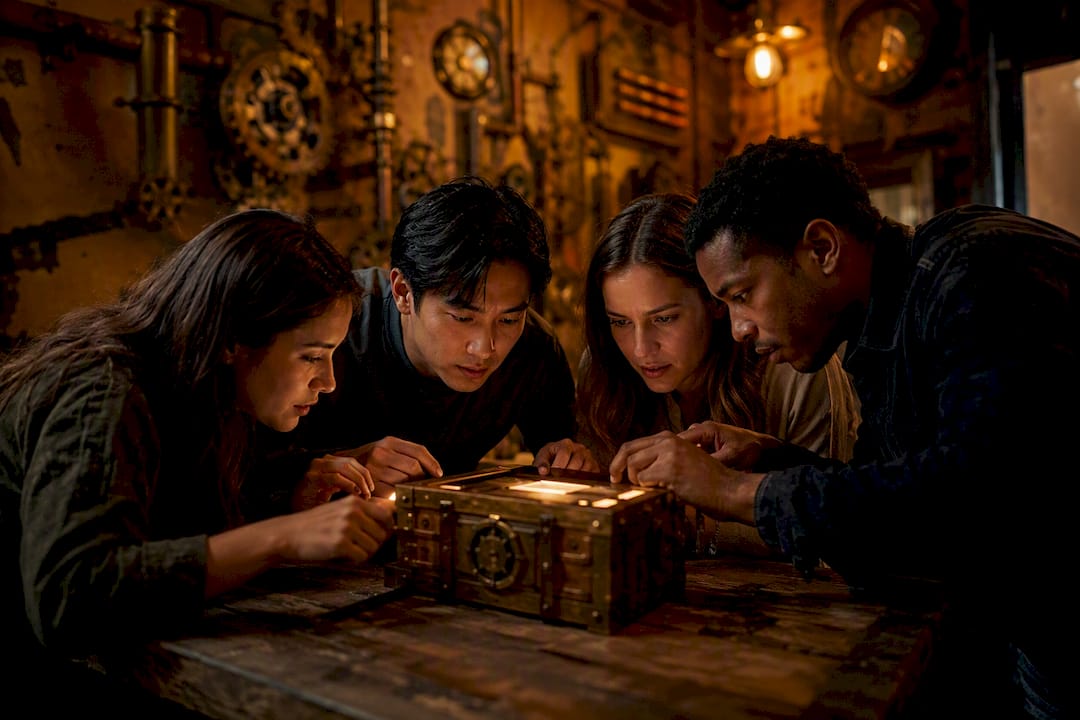
Look first for authentic hero shots and real group-in-action photos. They tell you more about an escape room than any marketing copy ever will. A gallery with only four or five images can still earn your trust if those images show real people mid-panic, real props under real lighting, and a real front desk you’ll actually walk up to. Aim for a room with at least several photos, and treat a gallery with more images as the sweet spot for a full picture.
CodeBusters Escape Room builds its own galleries around this exact logic, and it’s worth studying as a model before you scroll past ten other listings.
Before you book anywhere, check that the gallery includes:
- A hero shot that captures the room’s mood, not just its walls
- At least one group or celebration photo with real, unposed expressions
- A prop or texture closeup that hints at build quality
- A reception or staff photo confirming the place is real and staffed
Key Takeaways
Authentic hero shots, real group-in-action photos, and honest venue imagery are the three elements that most reliably predict whether an escape room will match its marketing.
| Point | Details |
|---|---|
| Prioritize the right photo types | Hero shots, group action photos, and people-enjoying-the-experience images most influence booking decisions. |
| Target 3 to 5 photos | Galleries below four images likely lack depth; several images cover hero, group, closeup, and venue shots. |
| Watch for authenticity cues | Natural expressions, imperfect framing, and visible staff signal real photos over stock or AI images. |
| Skip spoiler-heavy wide shots | Favor tight, atmospheric compositions and closeups that tease without revealing puzzle mechanics. |
| Ask before you assume | Request a recent group photo or short walk-through video if a gallery leaves questions unanswered. |
Table of Contents
- Gallery Basics: The Photo Types Every Room Should Show
- How Many Photos Do You Need to Judge a Room in 60 Seconds?
- How to Tell Real Photos From Stock or AI Images
- Avoiding Spoilers Without Flying Blind
- CodeBusters Spotlight: Why Our Photo Approach Reflects What We Build
- Reading Photos for Difficulty Level and Theme Fit
- High-Quality vs. Low-Quality Escape Room Photos: What Separates Them
- Judging Comfort and Accessibility From Lighting and Space
- What Actually Matters When You’re Judging Escape Room Photos
- Frequently Asked Questions
- Sources
Gallery Basics: The Photo Types Every Room Should Show
A strong escape room gallery isn’t random. It’s built from four categories, and each one answers a different question you’re silently asking as you scroll.
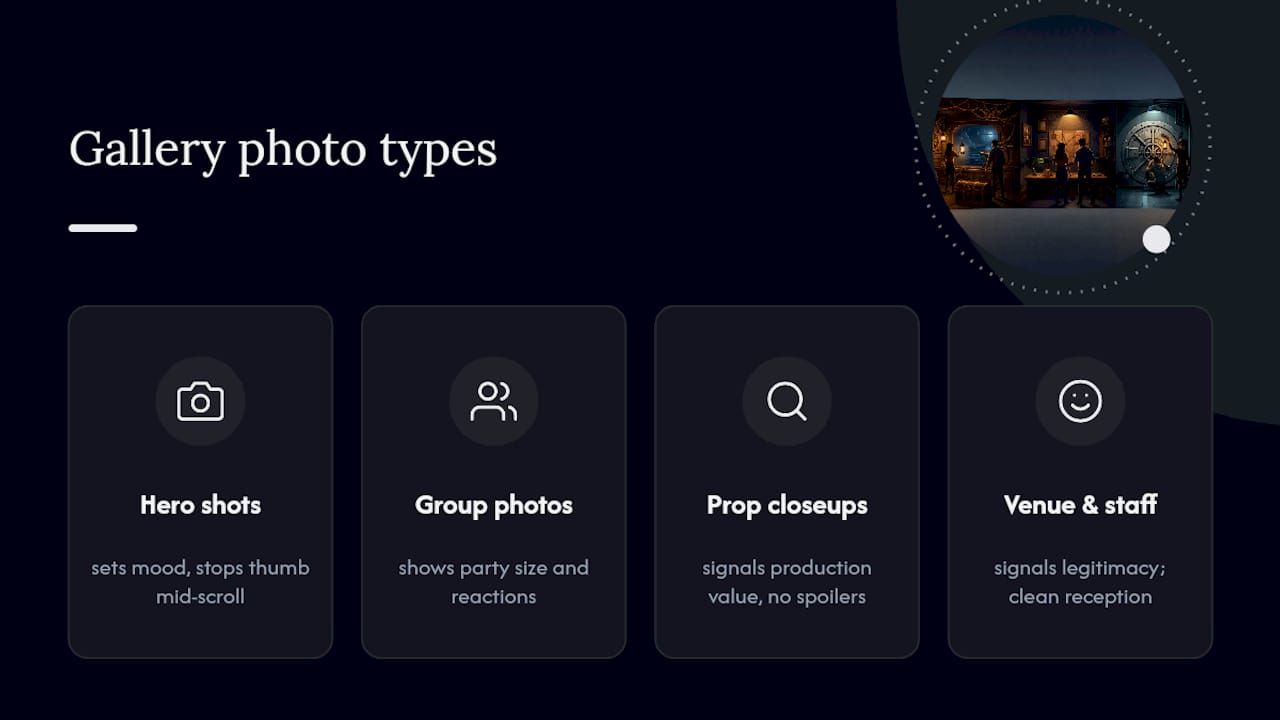
Hero and atmospheric shots set the tone before you read a single word of the room description. These are the wide, moody images, a control panel glowing red, a fog-filled corridor, that stop your thumb mid-scroll. They’re doing their job if you feel a flicker of “I want to be in that room” within two seconds.
Group and action photos work as social proof. A shot of six adults laughing over a locked box tells you the room fits a party of that size and that the puzzles create real, visible reactions, not just quiet head-scratching.
Prop and texture closeups hint at production value without giving anything away. A weathered journal, a rusted lock, a glowing crystal, these say “we built this,” without spoiling how it opens or where it leads.

Venue and staff shots matter more than most people expect. A clean reception area and a smiling game master signal legitimacy: this is a real business with real people running the show, not a rented storage unit with a fog machine.
Pro Tip: If a gallery skips reception and staff photos entirely, that’s often a sign the operator hasn’t invested in the customer experience outside the room itself.
How Many Photos Do You Need to Judge a Room in 60 Seconds?
You don’t need a hundred images to make a good decision. You need the right handful, in the right order.
- Start with the hero shot. It should tell you the theme and tone in under three seconds, sci fi, horror, mystery, comedy.
- Move to group or action photos. These confirm real players use the space and give you a sense of scale and energy.
- Check the closeups. Props and set dressing reveal how much craftsmanship went into the build.
- Finish with venue and staff photos. These confirm the operation is legitimate and well run.
Galleries with several photos satisfy many experience shoppers, and galleries with a larger number tend to satisfy even more, according to a survey on experience bookings. Anything smaller than a few should raise a question mark. Also glance at captions or upload dates. A gallery that hasn’t changed in three years, especially if the room has been “renovated” since, tells you the operator isn’t keeping pace with their own product.
How to Tell Real Photos From Stock or AI Images
Authenticity shows up in small, slightly imperfect details. Real photos usually have natural, half-caught expressions, someone mid-laugh, someone squinting at a clue, rather than everyone smiling straight at the camera. Framing tends to be a little off-center, lighting comes from the room’s actual fixtures instead of a studio softbox, and you’ll often spot a staff member or game master in the background doing their job.
Red flags run the other direction. Watch for:
- Compositions that look too clean or symmetrical, like a stock catalog shoot
- Generic backgrounds that could belong to any room in any city
- A mix of photo styles and resolutions that suggests some images were generated rather than shot
- Visible watermarks from stock photo services
Poor-quality or AI-generated photos measurably hurt trust and bookings, while authentic, up-to-date images strengthen both. That trust effect is notable: many travelers say listings with photos feel more trustworthy than those without, and the gap widens further when those photos look genuinely lived-in rather than staged for a catalog.
If you’re still unsure, cross-check the gallery against the venue’s Google Business profile or social media. Real venues tend to have overlapping, dated photos across platforms. If the website gallery and the Google listing show completely different rooms or eras, ask the venue directly before you book.
Avoiding Spoilers Without Flying Blind
The best galleries tease without revealing. A wide-angle shot of the entire room, showing every exit, every locked panel, every solved puzzle in plain view, does you no favors. It kills the mystery and, honestly, tells you less than a well-cropped closeup would.
Safer, more useful images include:
- Tight atmospheric shots that suggest scale without mapping the whole room
- Prop closeups shown without the surrounding context that would reveal their function
- Group photos taken mid-experience, focused on reactions rather than solutions
Operator guidance across the industry backs a curated approach: 3 to 5 strong images per room usually beat a sprawling twenty-photo gallery, and stock photography should be avoided entirely. Some venues go further and add spoiler labels or collapsible “reveal more” sections so spoiler-sensitive visitors can opt in or out.
Pro Tip: When scanning a gallery fast, skip any full-room panorama and go straight to the people shots and the reception photo. You’ll learn more about fit and legitimacy in five seconds than you would from a wide shot in thirty.
CodeBusters Spotlight: Why Our Photo Approach Reflects What We Build
CodeBusters Escape Room leans on themed hero shots, real celebration photos from finished groups, and reception imagery across both Colorado Springs locations, because that’s what actually helps a family or a corporate team decide with confidence. As a veteran and family-owned, award-winning operator running private bookings only, we treat the gallery as a preview of the experience itself, not a marketing afterthought.
Design guidance for escape room sites suggests using generated images only as temporary scaffolding while a venue builds out its real photo library. We’ve moved past that stage. Our blog on lighting in escape rooms walks through how we use light and shadow to set mood in rooms like Past to the Future and Stranger 80’s, the same choices you’ll notice reflected in our gallery photos.
Photos should do the same job a good friend does when they recommend a room: show you enough to trust the choice, without ruining the fun waiting inside.
If you want to see more than what’s posted, or you’re planning a private group event and want reassurance before committing, visit our booking page and ask for a private preview or explore our gift voucher options.
How to Request More Photos or a Quick Preview Before You Book
- Reach out through the booking page contact form, email, or a direct message on social media. Most venues respond within one to two business days.
- Ask specifically for what you need, a recent group photo, a reception shot, or a short 30 to 60 second walk-through video that avoids puzzle reveals.
- Expect a reasonable turnaround. A well-run venue should be able to send a couple of extra photos or a quick video clip without much delay, since they likely already have them on hand.
Reading Photos for Difficulty Level and Theme Fit
Difficulty rarely shows up as a number in a photo, but it shows up in details if you know where to look. Rooms packed with visible locks, control panels, and layered mechanical props tend to skew toward intermediate or advanced groups. A sparser, more narrative-driven set, fewer visible mechanisms, more scenery and storytelling elements, often signals a room built for beginners or mixed-age families.
Group photos are your best clue for age suitability. If every celebration photo features kids alongside adults, that’s a strong signal the room is family-tested. If the group shots skew toward adults only, or the theme art leans dark and intense (blood, horror imagery, dim lighting throughout), it’s probably not the pick for a family outing with younger children.
Theme suitability also comes through in the props themselves. A room built around Victorian science equipment and glowing time-travel devices, like CodeBusters’ Past to the Future, reads very differently in photos than a neon-soaked, retro-arcade setup like Stranger 80’s. If a venue’s photos consistently emphasize one era or aesthetic, the room design probably commits fully to that theme rather than mixing genres awkwardly. That consistency, visible across hero shots, props, and even reception decor, is often a better difficulty and fit signal than any star rating.
High-Quality vs. Low-Quality Escape Room Photos: What Separates Them
The gap between a great gallery and a mediocre one usually comes down to specificity. High-quality galleries show a mix of custom-built props with visible wear and detail, group shots with genuine, varied reactions, and staff who look engaged rather than posed. Low-quality galleries lean on generic decor that could belong to any themed venue, single stock-style shots reused across multiple rooms, or photos so dark and blurry you can’t tell what you’re looking at.
Watermarks are a quiet giveaway. A gallery mixing watermarked stock images with real photography usually means the operator hasn’t invested much in original photography, and that gap often extends to the room build itself. Another tell: repetition. If the same three photos appear across every room on a venue’s site with only the caption changed, the operator likely hasn’t documented each room individually, which raises real questions about how customized the rooms actually are.
The strongest signal, according to survey data on experience bookings, comes down to three photo types: wow-factor hero shots (chosen by 50% of respondents as most influential), photos showing the experience in action (49%), and images of people genuinely enjoying themselves (45%). Galleries that nail those three categories tend to be the ones worth booking.
Judging Comfort and Accessibility From Lighting and Space
Lighting in a photo tells you more about the physical experience than most people realize. A room photographed in near-total darkness with only prop lighting visible suggests a genuinely dim, immersive environment, which some players love and others find disorienting. If you or someone in your group is sensitive to low light or tight spaces, look for photos that show sightlines: can you see how much floor space exists between props? Are hallways narrow or open?
Ceiling height and clutter also matter more than they seem. Photos packed wall to wall with set pieces can look impressive, but they can also mean tight, maze-like movement for a group of eight. A room with visible negative space, walkways, open corners, breathing room around furniture, tends to be more comfortable for larger groups or anyone with mobility concerns.
Reception area photos are an accessibility clue too. A bright, open front desk area with clear signage suggests a venue that’s thought about the full guest experience, not just the puzzle rooms. If you have specific accessibility needs, photos are a starting point, but a direct question to the venue beats guessing from an image every time.
What Actually Matters When You’re Judging Escape Room Photos
Most advice on this topic gets stuck on gallery size, as if hitting some magic number of photos guarantees a good decision. It doesn’t. A gallery with five sharp, honest photos beats one with twenty repetitive or overly staged images every time.
The bigger blind spot is spoiler anxiety. Plenty of buyers avoid galleries entirely because they’re worried a photo will ruin the surprise, and plenty of venues overcorrect by hiding almost everything. Neither serves the customer. The right answer sits in the middle: show atmosphere, show real people having a real reaction, and save the puzzle mechanics for the room itself.
If you take one thing from this guide, prioritize people over props. A photo of a genuinely startled or delighted group tells you more about whether a room delivers than any prop closeup ever will. Production value matters, but reactions are the thing you’re actually paying for.
Frequently Asked Questions
How many photos should an escape room gallery have? Aim for a minimum of four, with seven to ten as the ideal range. That’s enough to show a hero shot, group action, prop closeups, and the venue itself without overwhelming you.
How can I tell if escape room photos are real or AI-generated? Look for natural, imperfect expressions, uneven framing, and visible staff or game masters. Generic backgrounds, watermarks, or overly symmetrical compositions are red flags.
Will looking at photos spoil the puzzles? Not if the gallery is built well. Tight atmospheric shots and prop closeups without context give you a feel for the room without revealing how anything works.
What if a venue’s gallery looks thin or outdated? Reach out directly. Ask for a recent group photo, a reception shot, or a short walk-through video. A responsive venue will usually have more images on hand than what’s posted publicly.
Do photos actually predict how good a room will be? They’re a strong indicator. Rooms with hero shots, genuine group reactions, and clear venue photos tend to reflect real investment in both the build and the customer experience.
Sources
- Five photo mistakes costing experience operators bookings - and how to fix them - Bókun
- New Study Exposes the Photo Blunders Silently Crushing Travel Bookings as AI Images Trigger Massive Trust Backlash - Travel And Tour World
- Escape Room Website Imagery (AI Image Scaffold) | designER guide
- Why you need photos of your escape room — ZOLITOPIA