Escape Room Win Rates: What to Expect and How to Improve

Most escape rooms let somewhere between a moderate and a majority of teams escape in the allotted time, depending on the room’s difficulty and how the operator defines a “win.” Beginner rooms often clear a majority of teams, while advanced or extreme rooms may have a minority escape. A study of 175 rooms by Scott Nicholson put the average success rate a bit less than half, and player-satisfaction research from Christy Byrd’s escape room lab found the number matters less than you’d think. Hint policies, sample sizes, and how an operator counts a “win” all shift these figures, so treat any single published percentage as a starting point, not gospel; for more on operational details like hint systems and pacing that influence completion rates, see Insights - TravelSearch Guru.
Key Takeaways
| Point | Details |
|---|---|
| Typical range | Most rooms report 20% to 60% escape rates, with a measured average near 41% across 175 rooms studied by Scott Nicholson. |
| Definitions vary | Operators count “escaped” differently, so compare hint policy and sample size before trusting a single published percentage. |
| Difficulty drives the number | Beginner rooms often exceed 60%, while advanced and extreme rooms can fall below 20%. |
| Role assignment and hints matter most | Clear roles, constant communication, and strategic hint timing raise your odds more than puzzle-solving talent alone. |
| Winning isn’t the whole experience | Players who don’t escape report enjoyment similar to those who do, driven largely by surprise and collaboration. |
| Codebusters designs for balance | Codebusters Escape Room calibrates difficulty labels and hint policies so groups can pick a realistic challenge level before booking. |
Table of Contents
- What Escape Rate Actually Means (and Why It’s Slippery)
- Typical Escape Room Success Rates by Difficulty Level
- What Actually Changes Your Odds of Escaping
- Can You Trust the Escape Rate an Operator Publishes?
- How to Improve Your Chances of Escaping
- Winning Isn’t the Whole Story
- The Difficulty Balance Most Rooms Get Wrong
- Ready to Test Your Odds?
- Frequently Asked Questions
- Sources
What Escape Rate Actually Means (and Why It’s Slippery)
An escape rate sounds simple: the percentage of teams that finish a room before the clock runs out. In practice, operators measure it in different ways, and that inconsistency explains a lot of the confusion around escape room statistics.
Some venues count a team as “escaped” only if they solve every puzzle with zero hints. Others count any group that reaches the final lock, even after a game master fed them three answers. A few exclude private corporate bookings from their public stats, since those groups often skew toward larger sizes and more nervous first-timers.
- One operator might report 70% because they count “mostly finished” as a win.
- Another might report 25% for the same difficulty level because they only count zero-hint completions.
- Trial-run data from a room’s opening weeks often gets folded into long-term averages, dragging the number in either direction.
The takeaway: two rooms with identical puzzle difficulty can post wildly different official percentages simply because of how the operator chooses to count. Our own breakdown of how clues shape the experience digs into how hint policy alone can swing a reported number by 20 points or more.
Typical Escape Room Success Rates by Difficulty Level
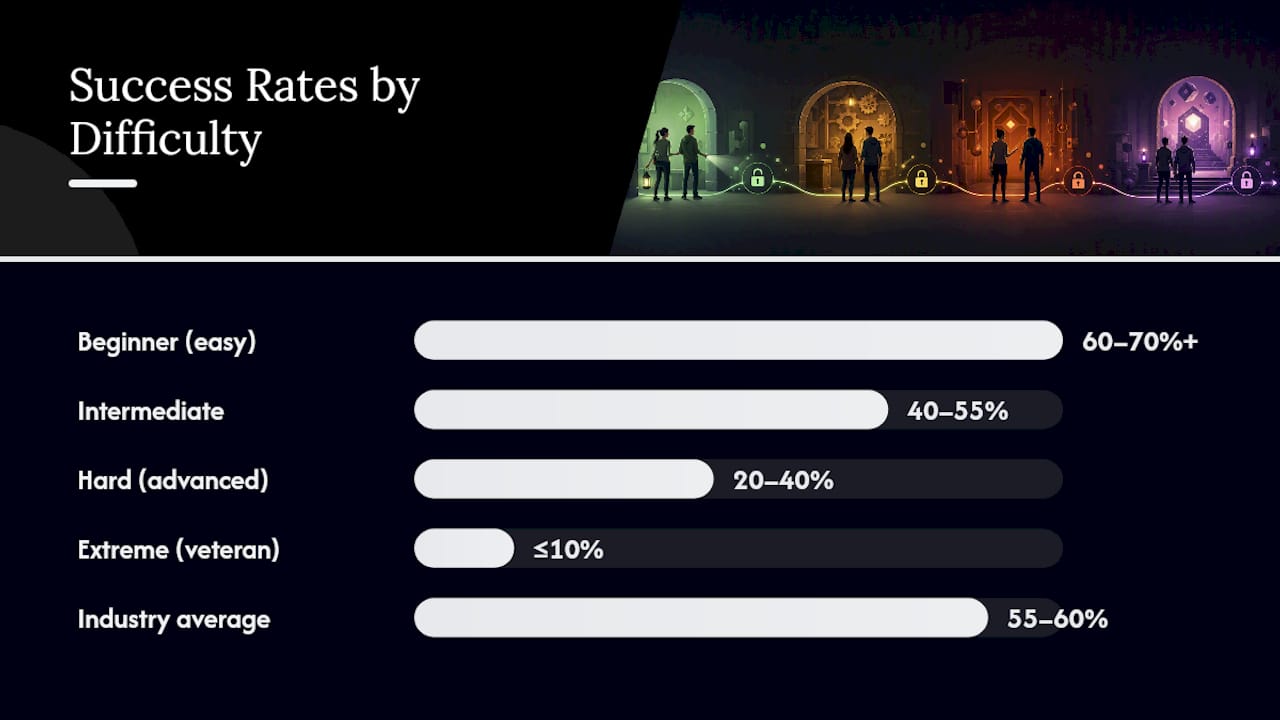
Difficulty tier is the single biggest driver of the number you’ll see on a room’s website. Here’s roughly how the bands break down, pulling from operator data and industry write-ups:
- Beginner/easy rooms: 60% to 70%+ escape rate, designed so most groups feel a sense of accomplishment.
- Intermediate rooms: 40% to 55%, the sweet spot most commercial venues aim for.
- Hard/advanced rooms: 20% to 40%, where puzzle chains get longer and hints get stingier.
- Extreme/veteran-only rooms: 10% or lower, sometimes intentionally near-unbeatable for enthusiasts chasing a real challenge.
An aggregate industry write-up puts overall averages closer to 55% to 60% across mixed difficulty catalogs, while a separate operator breakdown from Mission Escape Games places many individual rooms in the 20% to 40% band. Both can be true at once. It depends heavily on which rooms get counted and over what time period.
Why the spread? Geography, theme popularity, and even the season can nudge sample sizes small enough that a single busy weekend skews the annual number.
What Actually Changes Your Odds of Escaping
Six variables move the needle more than anything else, and most of them have nothing to do with luck.
- Puzzle design and clarity. Ambiguous clues frustrate teams and burn time; well-tested puzzles with a clear internal logic raise completion rates across the board. Our guide to what makes a room challenging breaks down the specific design choices that separate a fair challenge from a frustrating one.
- Hint policy and timing. Unlimited hints push win rates up; strict limits (or none at all) push them down fast.
- Game master pacing. A skilled game master reads a stuck team within minutes and nudges them without giving away the answer outright.
- Group size and experience. Four to six people with mixed skill sets typically outperform solo players or oversized groups where communication breaks down. Our post on how group size shapes success covers the tipping point where “more people” stops helping.
- Theme and tech complexity. Rooms relying on electronic props or multi-step tech puzzles tend to run lower completion rates simply because more can go wrong mechanically.
- Scoring and time pressure. A visible countdown clock changes team behavior, sometimes for the worse, by pushing rushed guesses over careful reasoning.
Pro Tip: Ask for a hint the moment you’ve tried more than one reasonable interpretation of a clue and hit a wall for over two minutes. Waiting past that point rarely produces a breakthrough. It just eats your clock.
Can You Trust the Escape Rate an Operator Publishes?
Treat published percentages as a rough signal, not a lab result. Several things routinely distort operator-reported numbers, according to both enthusiast reviewers and forum discussions among frequent players.
- Small sample sizes: a new room with 40 total plays can swing 15 points based on one unusually skilled or unlucky group.
- Cherry-picked timeframes: an operator might quote stats from a slower season when only die-hard fans booked the hardest rooms.
- Marketing rounding: “about half” often means anywhere from 42% to 58%, and the room’s site will pick whichever number sounds better.
- Inconsistent definitions: as covered above, “escaped” doesn’t mean the same thing everywhere.
Before trusting a number, ask three things: What sample size and timeframe does it cover? What counts as a hint, and how many are allowed? Is the rate for that specific room or an average across the whole venue? A rate under 10% usually signals either a genuinely brutal design or an unfair one, per Room Escape Artist’s analysis of difficulty.
How to Improve Your Chances of Escaping
- Prep before you arrive. Read the room’s difficulty rating and theme description so your group knows roughly what to expect. Check our beginner’s checklist if it’s your first time.
- Assign rough roles early. One person tracks time, one manages found items, one calls out loud when something clicks. Loose structure beats total chaos.
- Communicate everything out loud. Say what you’re looking at, even if it seems irrelevant. Silent solo puzzling is the most common way teams miss connections.
- Scan the whole room first. Teams that spend 60 seconds cataloging what’s visible before diving into one puzzle tend to spot patterns faster later.
- Use hints strategically, not reluctantly. A well timed hint often saves five minutes of spinning wheels.
- Delegate simultaneously. Split into two-person sub-teams working different puzzle threads instead of one giant huddle around a single clue.
Pro Tip: Put your most detail-oriented person on physical searching and your most logical thinker on cipher or math puzzles. Mismatched roles waste more time than any single tough puzzle.
Research aggregating operator data shows role assignment and disciplined hint use produce measurably higher completion rates than raw puzzle-solving skill alone.

Winning Isn’t the Whole Story
Here’s something the raw percentages don’t capture: whether you escape barely predicts whether you’ll have fun. Christy Byrd’s research on fun, surprise, and challenge in escape rooms found that players who didn’t escape reported enjoyment levels statistically similar to those who did. Surprise moments correlated more strongly with reported fun than the final outcome did.
That tracks with what shows up across satisfaction surveys generally:
- Unexpected story reveals or physical set transformations drive memorable moments more than a clean win.
- Group collaboration and inside jokes formed under pressure often outlast the memory of the actual puzzles.
- Teams that fail by a narrow margin (one lock, two minutes left) frequently report higher satisfaction than teams that cruised through easily.
It’s part of why we think about puzzle variety as much as difficulty when designing a room. A tough room that ends in a satisfying near-miss beats an easy one that ends in a shrug.
The Difficulty Balance Most Rooms Get Wrong
A room that lets everyone escape isn’t actually well designed. It’s just easy. First-time players should start with an intermediate room rather than jumping straight to the hardest option in the building. Repeat players chasing a real test should ask staff directly what percentage of groups escape without hints, not just the headline number on the website.

Ready to Test Your Odds?
Codebusters Escape Room designs its rooms so a near-miss still feels like a story finished, not a puzzle you got stuck on for an hour. Our two Colorado Springs locations run themed adventures like Past to the Future, Stranger 80’s, and Flight of Deception, each built with a difficulty level suited to families, first-timers, and veteran teams alike.

We won’t claim our rooms beat every other operator’s numbers. Every venue defines “escape” a little differently, and we’d rather you compare our stated difficulty labels and hint policies directly against any room you’re considering. What we can say is that our staff will tell you plainly which rooms run easier and which run tougher before you book, so you walk in with realistic expectations instead of guessing. If you want a room calibrated for your group’s experience level, check available booking times and room options at either Colorado Springs location, or browse our room selection guide to match a difficulty tier to your group before you reserve.
Frequently Asked Questions
What is a good escape room win rate? That range keeps the challenge real while still letting a meaningful share of teams reach the finale.
Why do some escape rooms have such low win rates?
Does group size affect escape room success? Yes. Groups of four to six with mixed skills tend to outperform very small or oversized teams, largely because communication and task-splitting get harder past a certain size.
Should I feel bad if my team doesn’t escape? No. Research on player satisfaction shows enjoyment often has little to do with whether you actually escaped, especially if the game included surprising moments or a close finish.
Sources
- FUN, SURPRISE AND CHALLENGE IN ESCAPE ROOMS
- How Difficult Should an Escape Game Be? | Room Escape Artist
- How Easy Should an Escape Room Be? | Fox in a Box Gold Coast
- Do Most People Finish Escape Rooms? The Real Success Rate Revealed
- What Is the Success Rate of the Best Escape Room NYC? - Mission Escape Games