Escape Room Age Limits: What Families Should Know First

Most escape room operators set a minimum age generally in the range from about 8 up to around 10 for family or junior rooms, allow teens in their mid-teens and older to play without a parent in the room, and generally discourage very young children from being active participants rather than spectators. If your group includes children younger than about 10, or a wide age spread, book a family-labeled room or a private session so staff can adjust hints and pacing on the fly.
Several factors determine whether your booking goes smoothly:
- An adult usually needs to be in the room or on-site whenever a group includes kids under approximately early teenage years, though the exact cutoff varies by venue.
- Anyone under 18 typically needs a guardian-signed waiver before the game starts, and filling it out online beforehand speeds up check-in.
- Very young children are often not counted as full participants for safety and capacity reasons, even if they’re welcome to watch.
Escape room age requirements aren’t arbitrary. They reflect real limits: reading level, working memory, fine motor skills for props, and how a 6-year-old handles a locked door versus how a 15-year-old does. Escape rooms are a form of live-action team puzzle game, and the puzzles inside them assume a baseline of problem-solving skill that toddlers simply haven’t developed yet.
Key Takeaways
Escape room age suitability comes down to three factors: the room’s minimum age, whether an adult must supervise in-room or on-site, and whether a private booking better fits a mixed-age group.
| Point | Details |
|---|---|
| Typical minimum ages | Family and junior rooms usually start around 8 to 10; teens 14 and up often play without a guardian present. |
| Supervision thresholds shift | Adults are commonly required in-room for kids under roughly 13, and on-site only for older teens. |
| Waivers are standard | Guardian-signed waivers are required for anyone under 18; filling them out online speeds up arrival. |
| Room theme matters as much as age | A scary or physically demanding room needs a higher age threshold than a puzzle-driven family room, regardless of the posted minimum. |
| Codebusters Escape Room offers private, family-friendly bookings | Codebusters Escape Room provides junior-appropriate rooms and private sessions so mixed-age families can play together comfortably. |
For further reading, the Wikipedia overview of escape rooms covers the format’s basics, while Escape The Room’s family page and Key to Escape NC’s FAQ show real examples of operator age and waiver policies.
Table of Contents
- Escape Room Age Limits by Age Band: What to Expect
- Waivers, Supervision, and Safety Rules Worth Confirming
- How to Match Room Difficulty and Theme to Your Group’s Ages
- Venue-Backed Tips for Mixed-Age Groups
- Do Age Limits Change by Region or Country?
- Sources
Escape Room Age Limits by Age Band: What to Expect
Age policies aren’t one-size-fits-all, and the differences between a 6-year-old and a 12-year-old in a locked room are bigger than most parents expect.
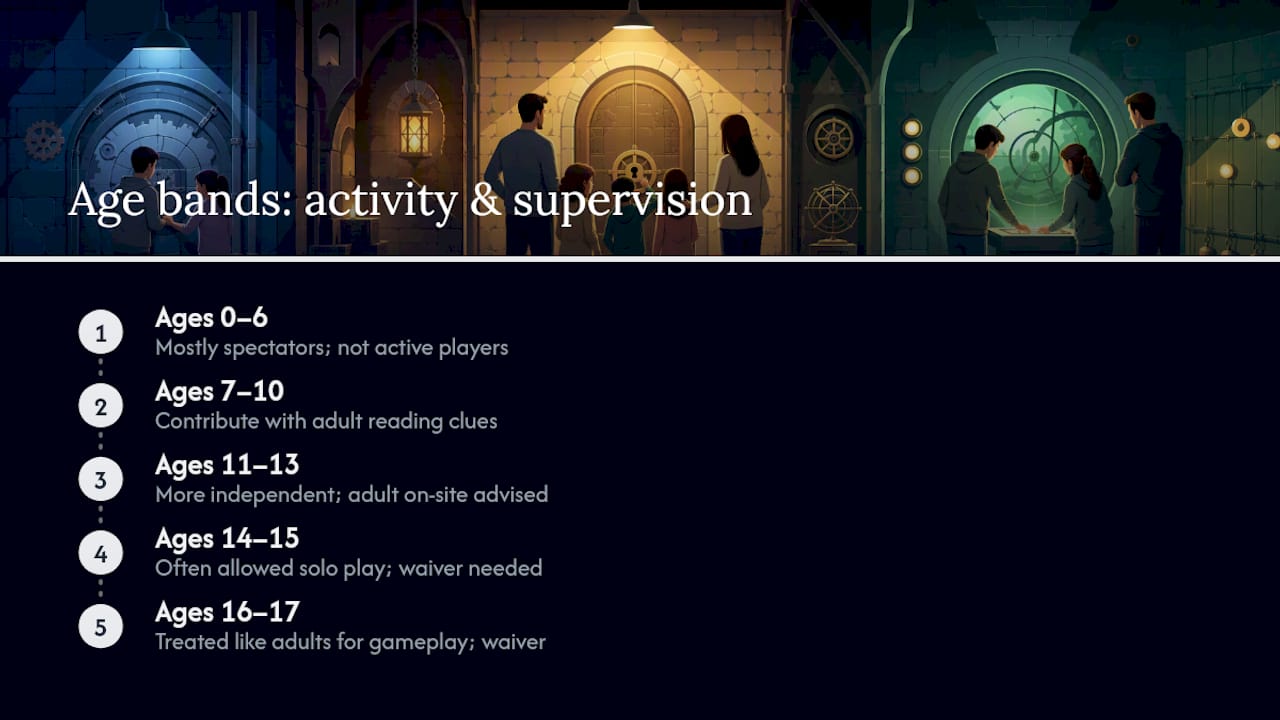
Ages 0 to 6. At this age, kids are mostly spectators. They can tag along, but capacity limits and the physical nature of some puzzles (climbing, reaching, manipulating small objects) mean they usually aren’t treated as active players. Some venues won’t count them against the room’s headcount; others will, so ask before you book.
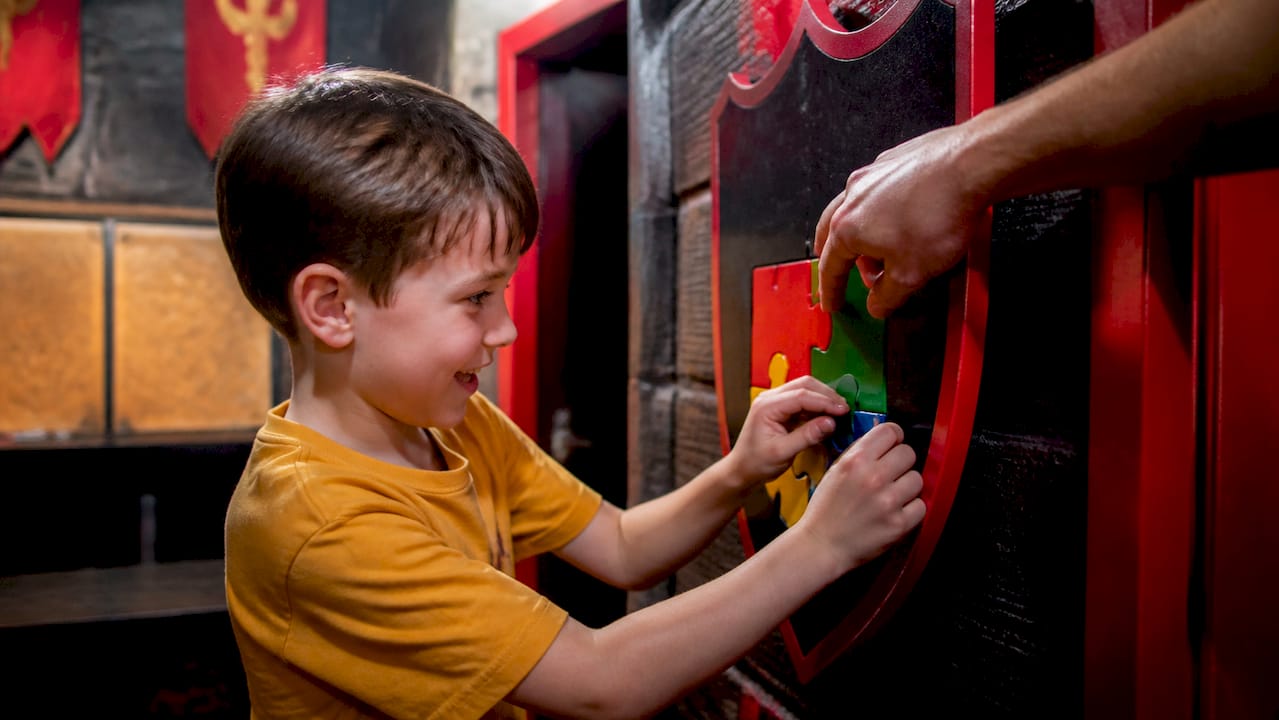
Ages 7 to 10. This is where junior and family rooms come alive. Kids in this range can meaningfully contribute when paired with an adult who reads clues aloud, points them toward objects, and manages the trickier locks. Family-oriented operators often set the minimum age for family rooms at 8, with an adult required for anyone younger.
Ages 11 to 13. Independence grows fast here. Some kids in this band can handle a mid-difficulty room with an adult simply on-site rather than hovering over their shoulder, though a genuinely hard room still benefits from in-room supervision.
Ages 14 to 15. Many operators let teens this age play without a guardian physically present, though the guardian still has to sign the waiver. Rules vary enough that this is worth confirming directly with the venue.
Ages 16 to 17. Teens are usually treated close to adult status for gameplay purposes. They can play solo groups or join adult friend groups, provided the waiver’s on file.
Look for rooms tagged “junior” or “family,” and check the description for low physicality and non-scary themes if your group skews young.
Waivers, Supervision, and Safety Rules Worth Confirming
Before you book, run through these checks:
- Ask whether the adult needs to be in the room or just on-site. The threshold where this changes is usually somewhere between 13 and 16, and it shifts based on the room’s difficulty and theme.
- Fill out waivers online in advance. Guardian-signed waivers are standard for anyone under 18, and pre-filling them online avoids a slowdown at the front desk.
- Ask if infants count toward room capacity. Fire codes and safety limits sometimes mean a baby in a carrier still counts as a body in the room, which can affect group size and pricing.
- If you’re considering a virtual or online escape game instead of an in-person room, check the recommended age separately. Many virtual formats are built with older teens and adults in mind and aren’t a straight substitute for a physical family room.
Pro Tip: Call ahead and ask specifically “what’s your adult supervision rule for a 9-year-old in your easiest room?” Generic FAQ language often doesn’t cover edge cases, and staff will usually give you a straighter answer over the phone than what’s posted online.
How to Match Room Difficulty and Theme to Your Group’s Ages
Picking the right room matters more than picking the right time slot. A room built around a horror theme with jump scares is a different experience for an 8-year-old than a colorful mystery room with a friendly narrator, even if both technically allow kids.
- Scan the room description for words like “family,” “junior,” or “all ages,” and read past the marketing copy for mentions of loud noises, darkness, or physical props.
- Choose a lower difficulty rating and a room known for generous or unlimited hints when younger kids are involved. Family rooms with unlimited hints or extra game-master support keep sessions fun instead of frustrating for kids still building puzzle-solving stamina.
- Book privately, rather than joining a public group session, whenever your party includes very young children or a wide age spread. It protects your kid’s experience and keeps you from holding up strangers.
- Before you commit, ask staff three things: the room’s actual minimum age, its hint policy, and whether any props require strength or height a smaller kid might not have. Our difficulty levels breakdown walks through how ratings translate to real gameplay.
Venue-Backed Tips for Mixed-Age Groups
Years of watching families move through rooms with kids ranging from 6 to 16 in the same group have taught us a few things that FAQ pages don’t cover.
Assign the adult as the “hint guardian” for kids roughly 5 to 11. That means the adult reads clues aloud and nudges attention toward the right object, without solving the puzzle outright. Kids stay engaged because they still get the “aha” moment.
- Give younger kids small, concrete jobs: “find the red key,” “count how many symbols match.” Abstract instructions like “help us solve this” tend to lose them fast.
- Rotate who leads each puzzle so no single kid (or adult) dominates the session.
- Book a private room or a family-designated slot whenever kids under 10 are involved. It removes the pressure of a ticking clock in front of strangers.
- Walk through basic safety expectations before the door closes: no forced climbing, gentle hands on props, and a clear “we can always ask for a hint” reminder.
Our parent-child dynamics guide and mixed-age group tips go deeper into managing personality clashes and keeping quieter kids from checking out.
Booking Checklist: The Two-Minute List Before You Go
- Confirm the minimum age and supervision rule for the exact room you’re booking, not just the venue’s general policy.
- Ask whether infants count toward room capacity, and check whether a private booking is available for your group size.
- Fill out waivers online ahead of time, and bring photo ID if a guardian signature needs verifying at check-in.
- Double-check arrival time, parking, accessibility needs, and any content warnings tied to the room’s theme.
Do Age Limits Change by Region or Country?
Escape room age policies aren’t governed by any single law or standard body. There’s no national or international agency setting a universal minimum age, so every rule you see comes from the individual operator, not a regulation.
That means the same theme can carry a different minimum age depending on which country, state, or even city you’re in. A haunted-house-style room in one market might be rated 13 and up, while a similarly themed room elsewhere allows 10-year-olds with a parent present, simply because local operators made different calls about intensity and liability. Insurance requirements and local fire codes also shift by jurisdiction, which affects how strictly a venue enforces capacity limits involving infants or very young children.
Cultural norms play a role too. Family entertainment markets that lean heavily into horror or intense sensory experiences tend to set higher minimum ages across the board, while markets built around puzzle-and-mystery themes skew more permissive for younger kids. If you’re traveling and planning to book a room away from home, don’t assume the age rule you’re used to locally will match what you find elsewhere. Always check the specific venue’s posted policy rather than relying on general expectations from past bookings.
Publisher Perspective: Why Flexible Family Policies Improve the Experience
Age rules aren’t about excluding kids. They exist to protect safety and keep the experience good for everyone in the room, including the family right behind yours. Codebusters Escape Room leans on private bookings and family-friendly room design specifically so a 7-year-old and a 15-year-old can play the same session without either one being bored or overwhelmed. If your family has a specific need, sensory sensitivities, a very young child, mobility considerations, reach out to staff directly before booking. A quick conversation solves more than any FAQ page can.
— CodeBusters
A Practical Option for Family and Mixed-Age Bookings
If you’ve read this far because you’re trying to figure out whether your specific group can actually play together, that’s the exact problem private bookings solve. Codebusters Escape Room offers family-friendly rooms built with junior-appropriate puzzles and adjustable hint support, plus private sessions so your group isn’t mixed in with strangers while you figure out the right pace for your kids.

You can check age suitability for a specific room, complete waivers ahead of time, and ask about supervision requirements before you arrive. Our safety guidelines page covers what to expect on-site, and if you’re still deciding on timing or logistics for a bigger family outing, Wild Foodz’s family travel planning guide has useful tips on syncing nap schedules and travel time around an activity like this. When you’re ready, visit Codebusters Escape Room to check room availability and book the session that fits your group’s ages best.